
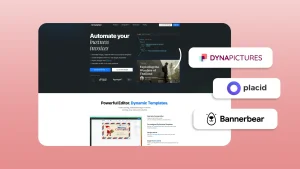

Where Templated Runs Into Limits When Alternatives Do Not
Templated has done a lot of things right. The AI template generator removes design friction from the start.
Canva import means existing templates aren’t wasted.
The white-label embeddable editor is genuinely useful for SaaS builders who need image creation capabilities inside their own product.
And the integration list includes Zapier, Make, Bubble, n8n, which is solid.
The Starter plan is where friction builds: 15-template limit, 2-user cap, and 50 trial credits that expire with no permanent free tier.
Video was recently added but is still maturing as a feature.
If those limits have become the problem, or you’re evaluating before committing, these 10 Templated alternatives are worth knowing.
1. DynaPictures
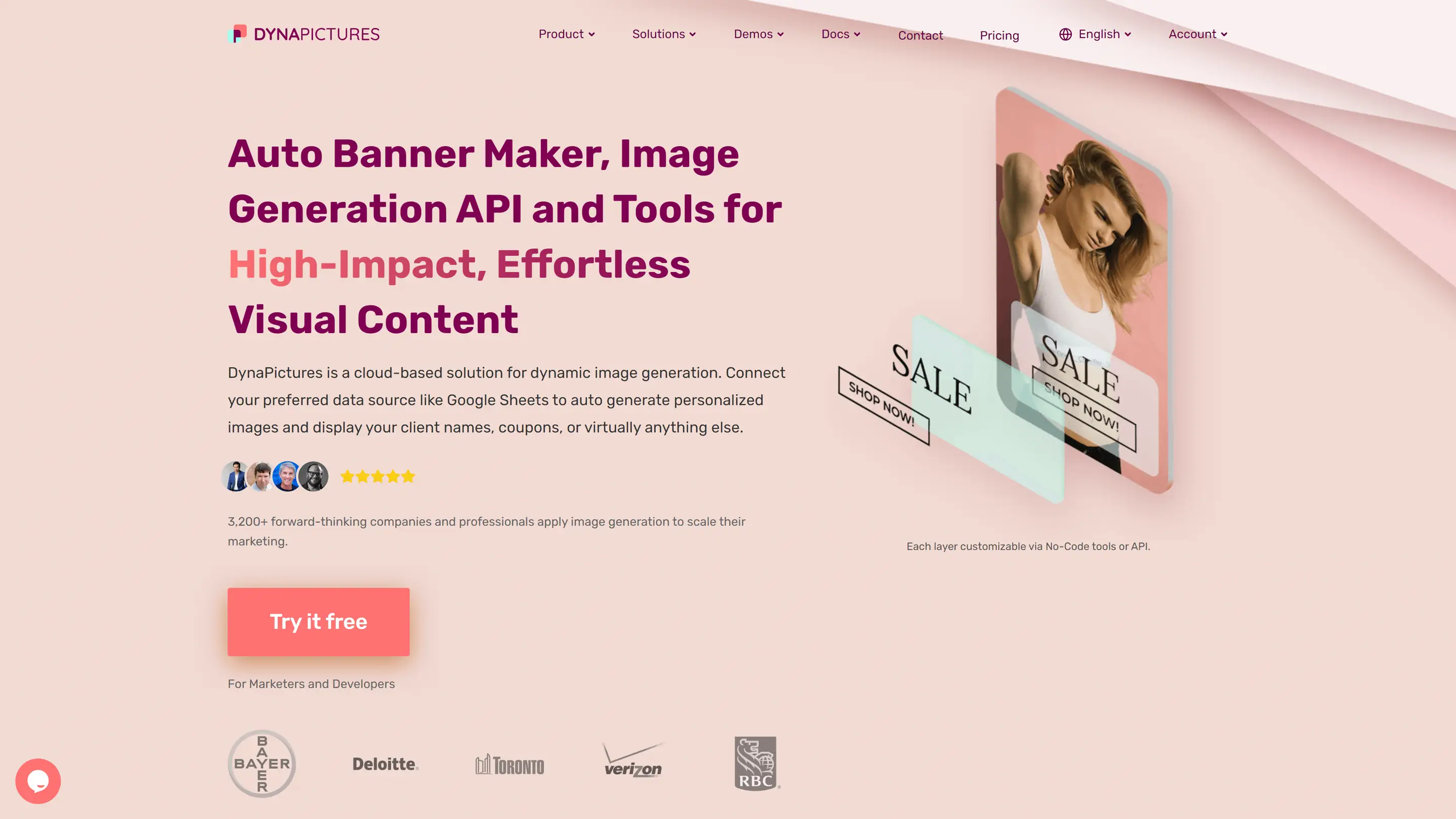
DynaPictures removes the constraints that Templated’s Starter plan imposes: no template count limit on any plan, no team member caps, API access from the first paid tier, and a 14-day trial on any plan. There’s no credit card needed to access the platform and try any plan.
- No template count limits and no team member limits on any plan.
- Synchronous API at 200–300ms. Templated doesn’t publish speed benchmarks.
- Own Frankfurt server infrastructure, GDPR compliant by design, DPA available.
- AI image generation: 12 models (Stable Diffusion, DALL-E, FLUX, and more) with an AI prompt library.
- Smart cropping and face detection for headshot-based templates.
- Native countdown timers with analytics and open tracking.
- Event marketing widget for speakers and attendees to create their own banners.
- Multi-page templates, animated GIFs, AVIF, PDF, and PPTX output.
- White-label embeddable editor
- Email countdown timer and native ESP integrations: Mailchimp, Drip, ConvertKit, ActiveCampaign, Inxmail, MailerLite.
DynaPictures doesn’t currently support Canva import, which may be a drawback if your existing workflow depends heavily on Canva templates. Paid plans start at €39/month, or teams can purchase 1,000 credits for $20. A 14-day free trial is available with no credit card required.
Paid plans start from EUR 39/month with a 14-day free trial. No credit card required.
2. Bannerbear
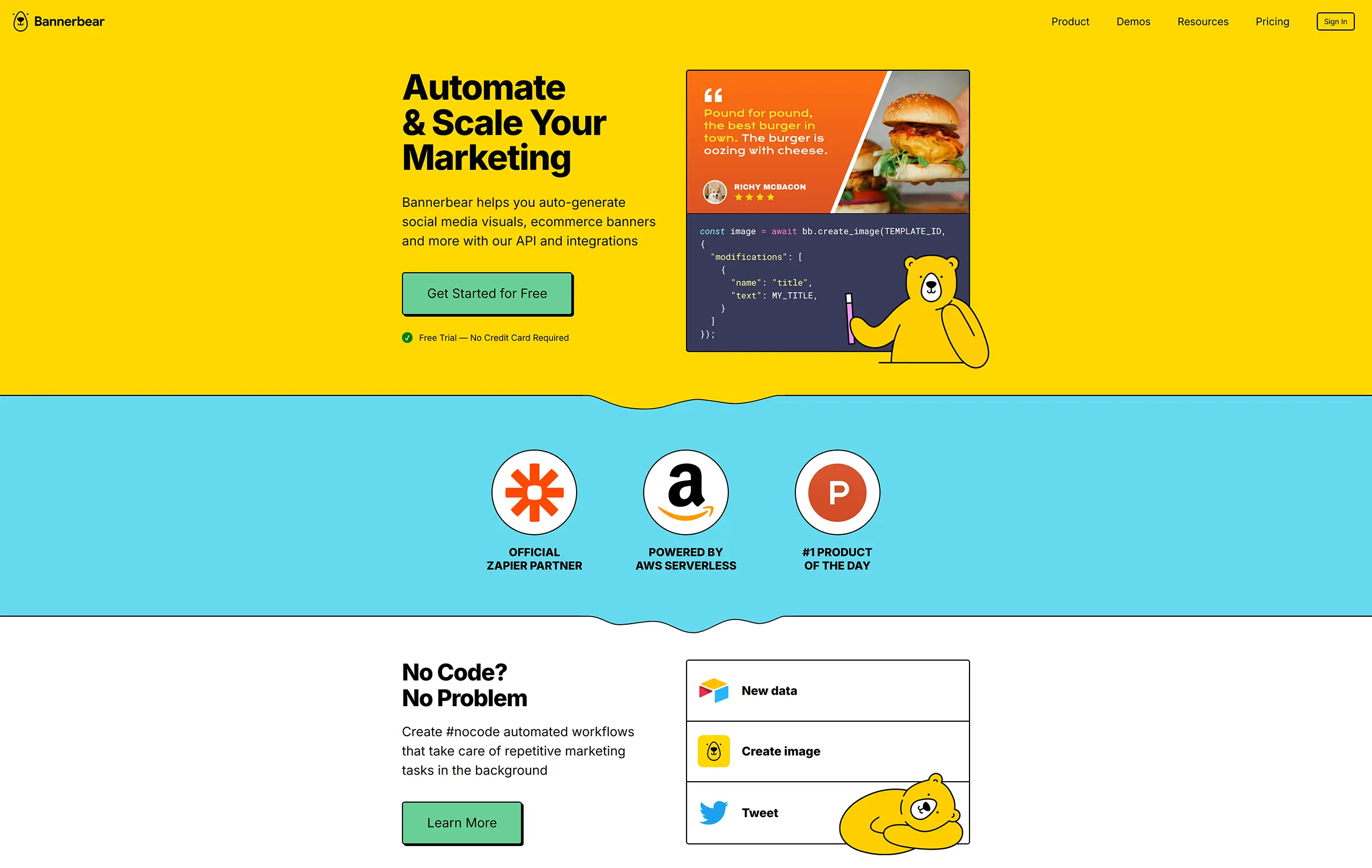
Bannerbear is a mature API-first alternative for teams that want to automate image and video creation programmatically. It doesn’t impose template count limits on its standard plans, making it a better fit than Templated for teams whose template library is growing beyond a small collection.
Its API is designed with developers in mind, and SDK support for Ruby, Node.js, Python, PHP, and Go gives engineering teams several familiar ways to integrate automated image generation into their applications. It also has a relatively large template ecosystem, which can help teams get started without designing every template from scratch.
Bannerbear is particularly well suited to workflows where images need to be generated automatically from structured data, such as social posts, product images, personalized graphics, or marketing content. However, its API is asynchronous, so it isn’t the best choice when an application needs an image returned immediately as part of a synchronous user experience.
Plans start at $49/month. There is no permanent free plan, and GDPR compliance isn’t positioned as a built-in infrastructure differentiator in the same way as EU-hosted alternatives.
3. Placid
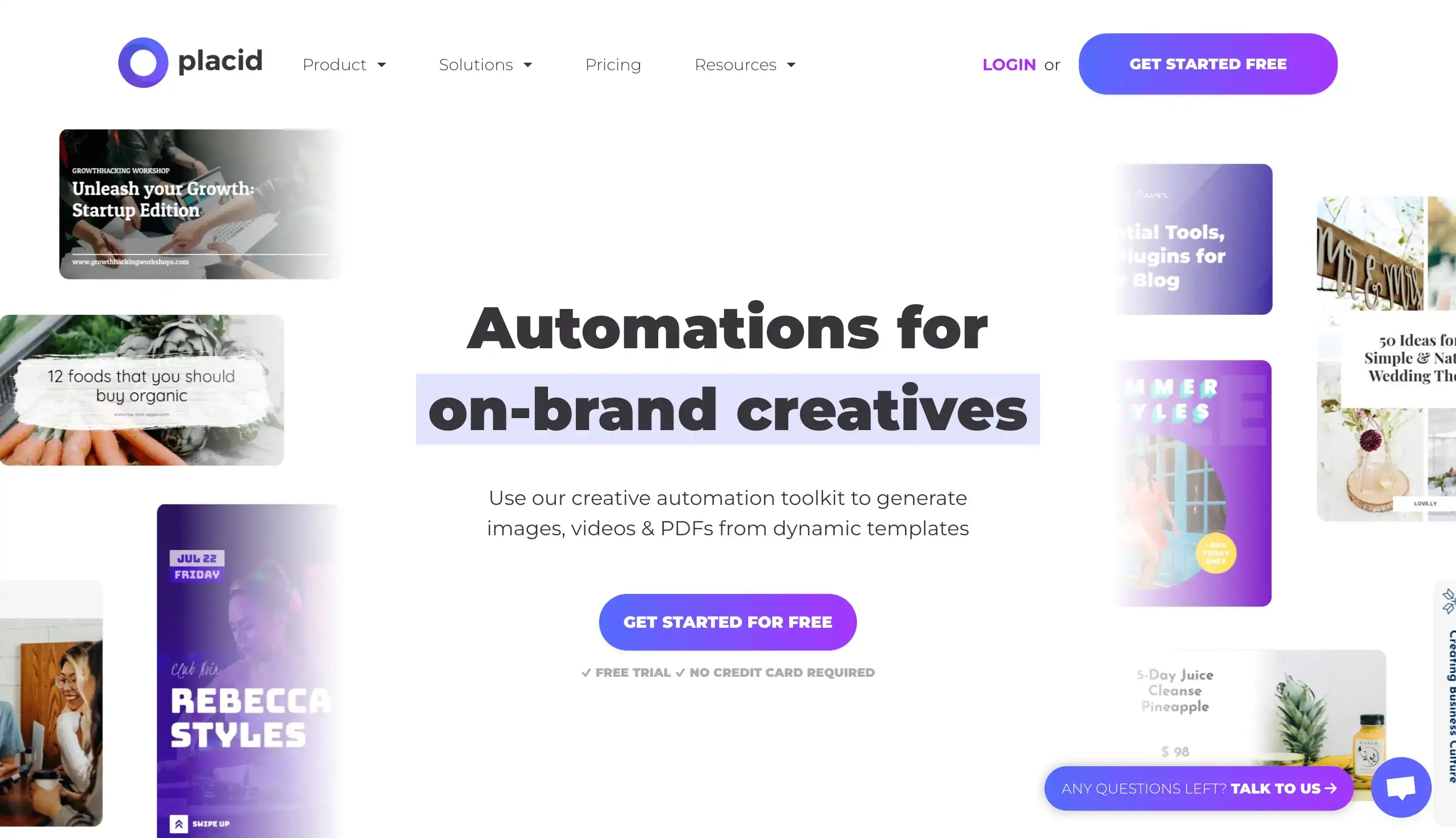
Placid is a good Templated alternative for marketing teams and no-code users who want to automate visual content without building everything through an API. Its integrations with platforms such as Webflow and WordPress make it especially useful for teams that need to generate images as part of existing website and content workflows.
The platform also works with automation tools such as Zapier and Make, allowing teams to connect image generation to forms, databases, CRMs, and other business processes without extensive development work. There is no per-seat pricing, which can make it easier to roll out across a marketing team than tools that charge separately for every user.
Placid also offers credit rollover, which is useful for teams with inconsistent monthly workloads. Unused credits don’t necessarily have to disappear at the end of every billing period, making costs more predictable when image-generation demand fluctuates.
The main trade-off is that the API is asynchronous, and the embedded editor is restricted to higher-tier plans. There is also no permanent free plan. Paid plans start at $19/month.
4. Abyssale
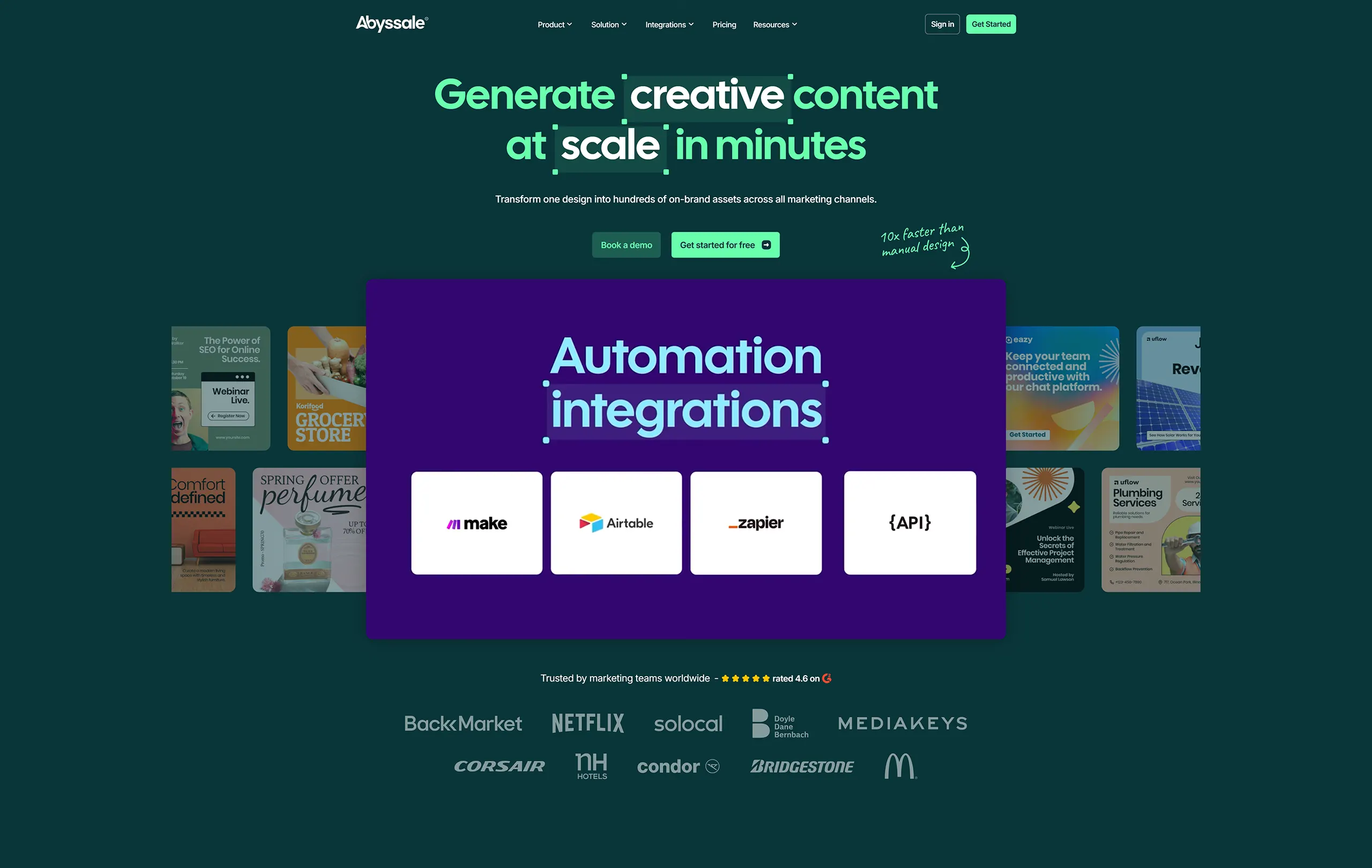
Abyssale scales further than Templated into multi-format campaign production, the same creative across dozens of formats simultaneously, with localisation, HTML5 ad support, and approval workflows. Better fit for agencies that need brand review processes built in.
Teams can generate creative in multiple formats, localize campaigns, support HTML5 ads, and incorporate approval workflows into the production process. That makes Abyssale particularly useful when the challenge isn’t simply generating an image, but coordinating the production and review of hundreds or thousands of creative variations.
The trade-off is cost and complexity. API access is per seat, so the pricing can become difficult to justify for small teams or developers who only need programmatic image generation. Teams that don’t need campaign management, approvals, or large-scale ad production may be paying for capabilities they won’t use.
Per-seat pricing at $45/seat for API access. Not cost-effective for small teams.
5. Creatopy / The Brief
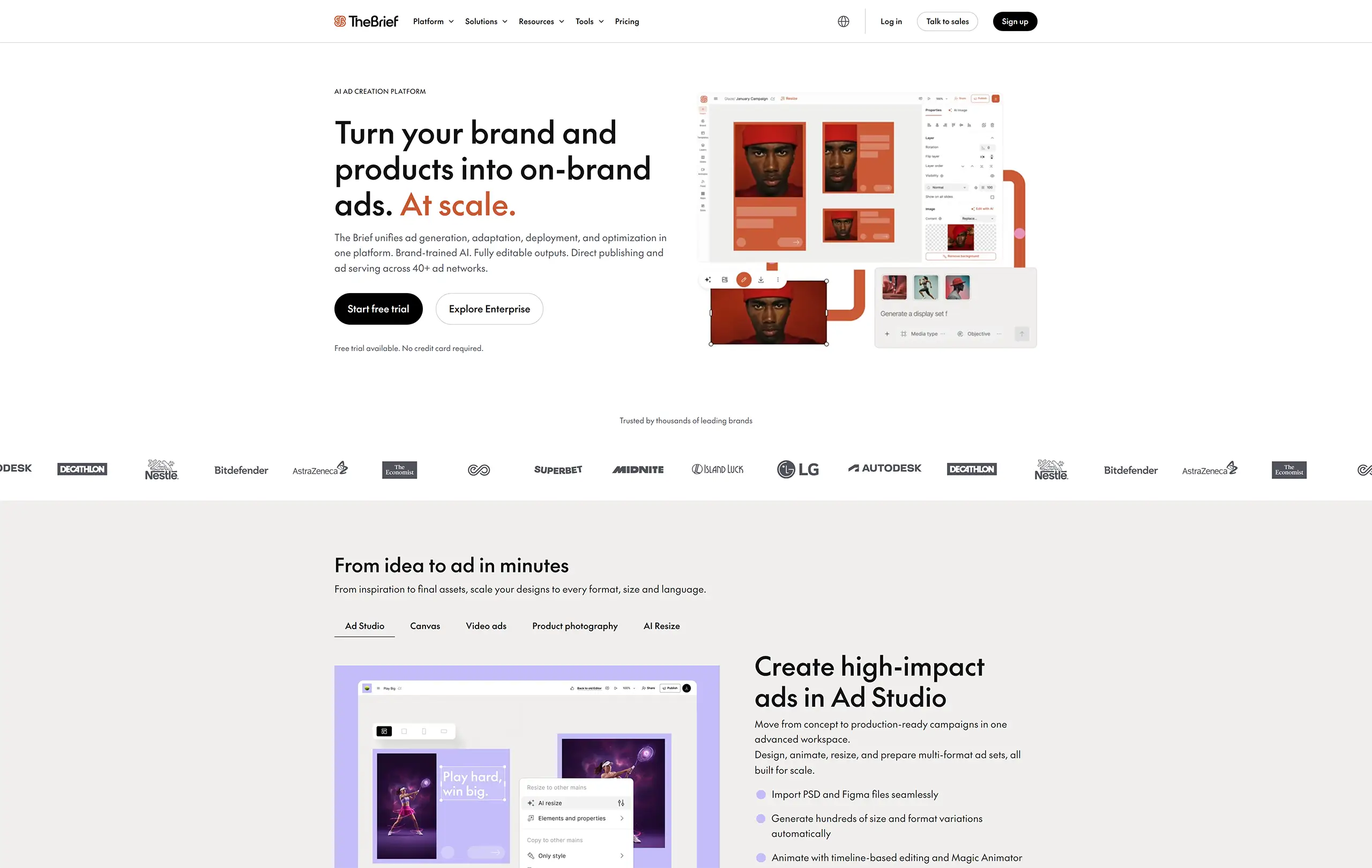
If your Templated workflow was centred on ad creative that needs publishing to paid channels, Creatopy (The Brief) adds direct publishing to Meta, Google, and TikTok on top of creative production. Its AI capabilities can help generate ad concepts and variations, while multi-channel campaign management gives marketing teams a more complete workflow from creative production through publishing. This makes it a particularly relevant alternative for performance marketing teams that want to reduce the number of tools involved in creating and launching ad campaigns.
However, it is positioned considerably further upmarket than most API-focused image generation platforms. API access is enterprise-only, as is pricing, so smaller teams may find the platform difficult to access or difficult to justify compared with developer-focused alternatives.
API is enterprise-only, so is the pricing. Upmarket positioning makes it inaccessible for teams without an enterprise contract.
6. Orshot
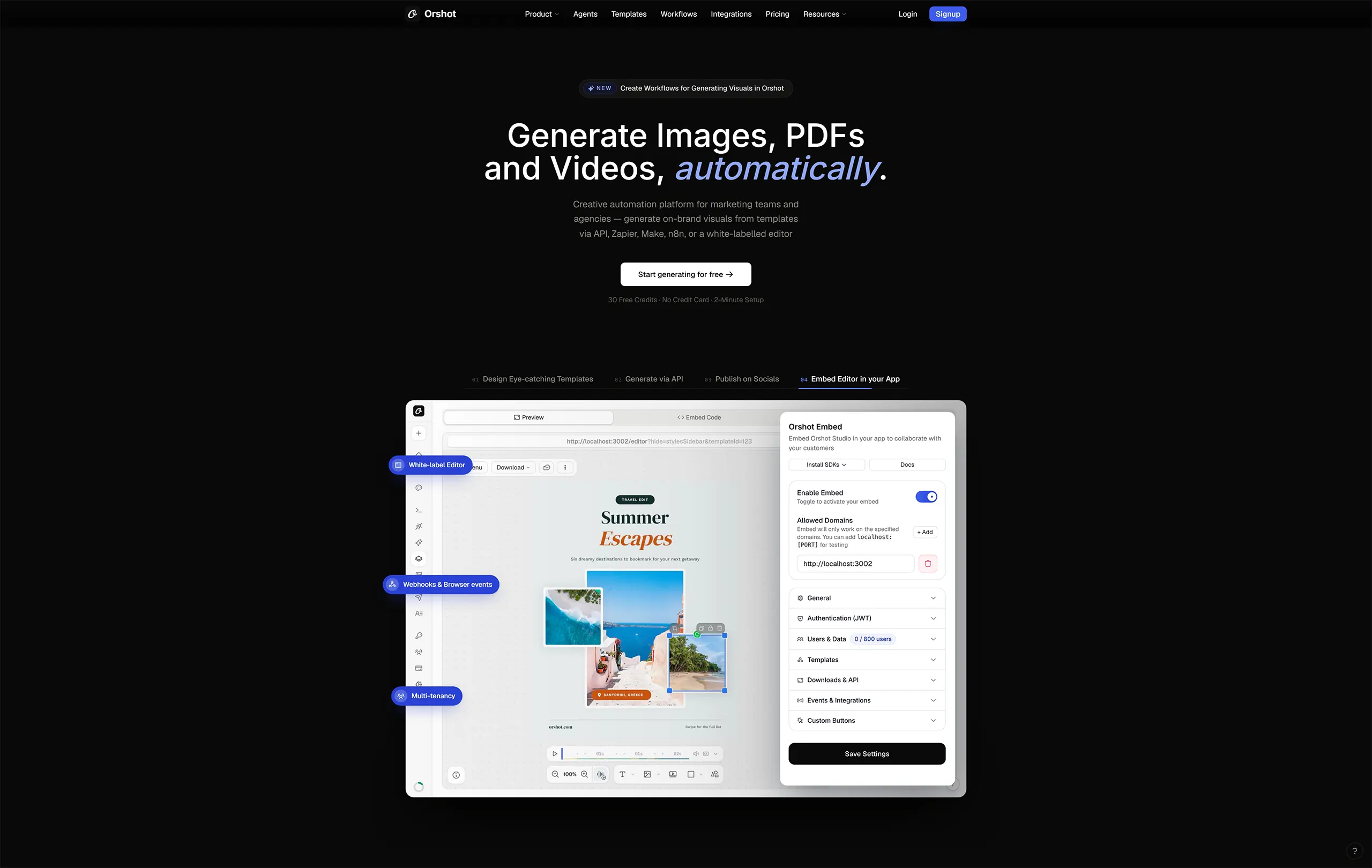
Like Templated, Orshot (2025) supports Canva import — and adds Figma import, which Templated doesn’t have. Per-image pricing at $0.01 at scale, plus white-label embed from $39/month, makes it a credible alternative for teams where import and pricing are the primary drivers.
New platform with a maturing template library and ecosystem. Free tier is 60 one-time credits, not a monthly recurring allowance. Orshot’s privacy policy (published May 2026) confirms UK/EU GDPR compliance, names a legal basis for processing, and offers a Data Processing Agreement for enterprise customers. One gap worth noting: the policy doesn’t specify where data is physically stored — the infrastructure providers listed (Supabase, Railway, Vercel, Cloudflare R2) all support multi-region deployment but no region is stated. DynaPictures’ Frankfurt infrastructure is named explicitly, which gives EU teams a clearer answer on data residency.
Prices start from $39/month.
7. Creatomate
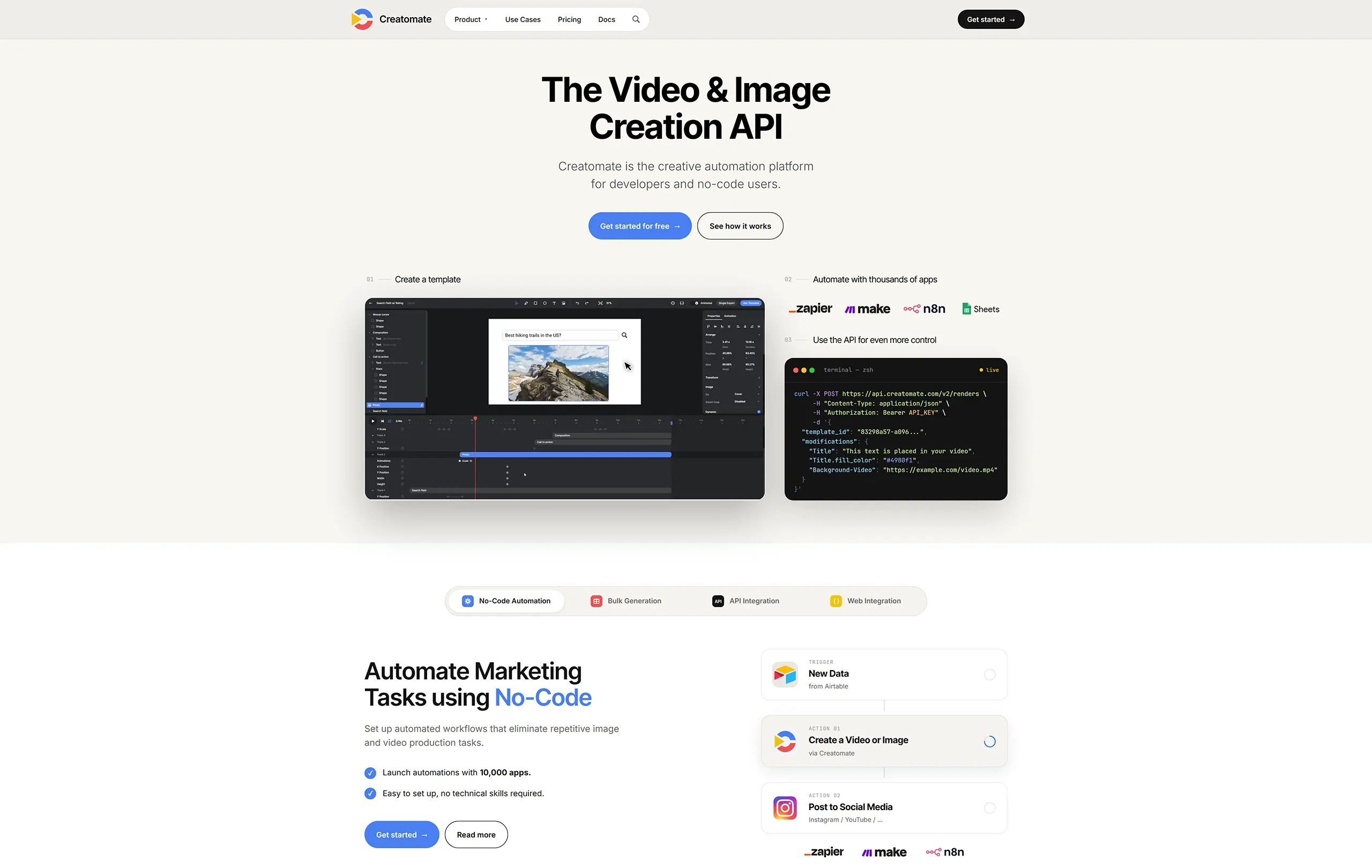
Creatomate is the tool to consider if Templated’s newly-added video feature isn’t robust enough. Purpose-built multi-scene video with transitions and text-to-speech narration. It’s the most capable video generation tool in this category.
This makes it particularly useful for teams generating personalized marketing videos, social content, product videos, or other dynamic video assets from structured data. Its video capabilities are more central to the product than they are to most image-generation APIs, making it one of the stronger choices when video is the primary requirement. Teams that need serious programmatic video generation alongside automated creative production.
Prices are at $54/month with no permanent free plan. Image template flexibility is lower than image-focused tools.
8. APITemplate.io
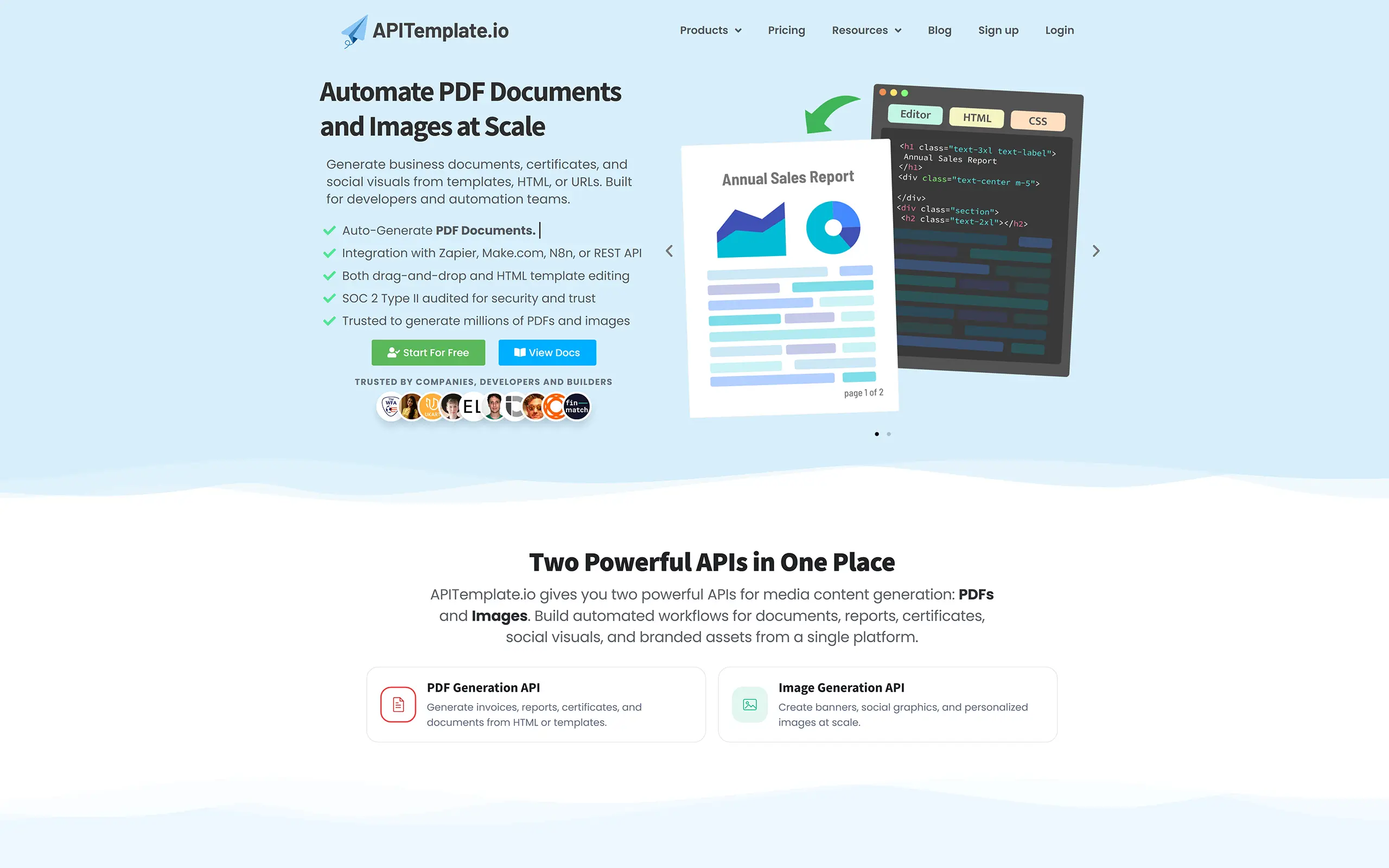
APITemplate.io offers both image and PDF generation from HTML/CSS templates, overlapping with Templated’s PDF support but through a code-based approach. A free plan provides 50 renders per month, giving teams a way to test the API before committing to a paid plan.
Instead of relying primarily on a visual template editor, APITemplate.io lets developers create templates using HTML and CSS. This can be an advantage when the engineering team wants precise control over layout and already works comfortably with web technologies. It can also make complex or highly customized templates easier to maintain through code.
The downside is that this approach requires more developer involvement. Marketing or design teams can’t necessarily make template changes independently in a visual editor, so it’s less suitable for organizations looking for a no-code creative workflow.
There’s a free tier available.
9. RenderForm
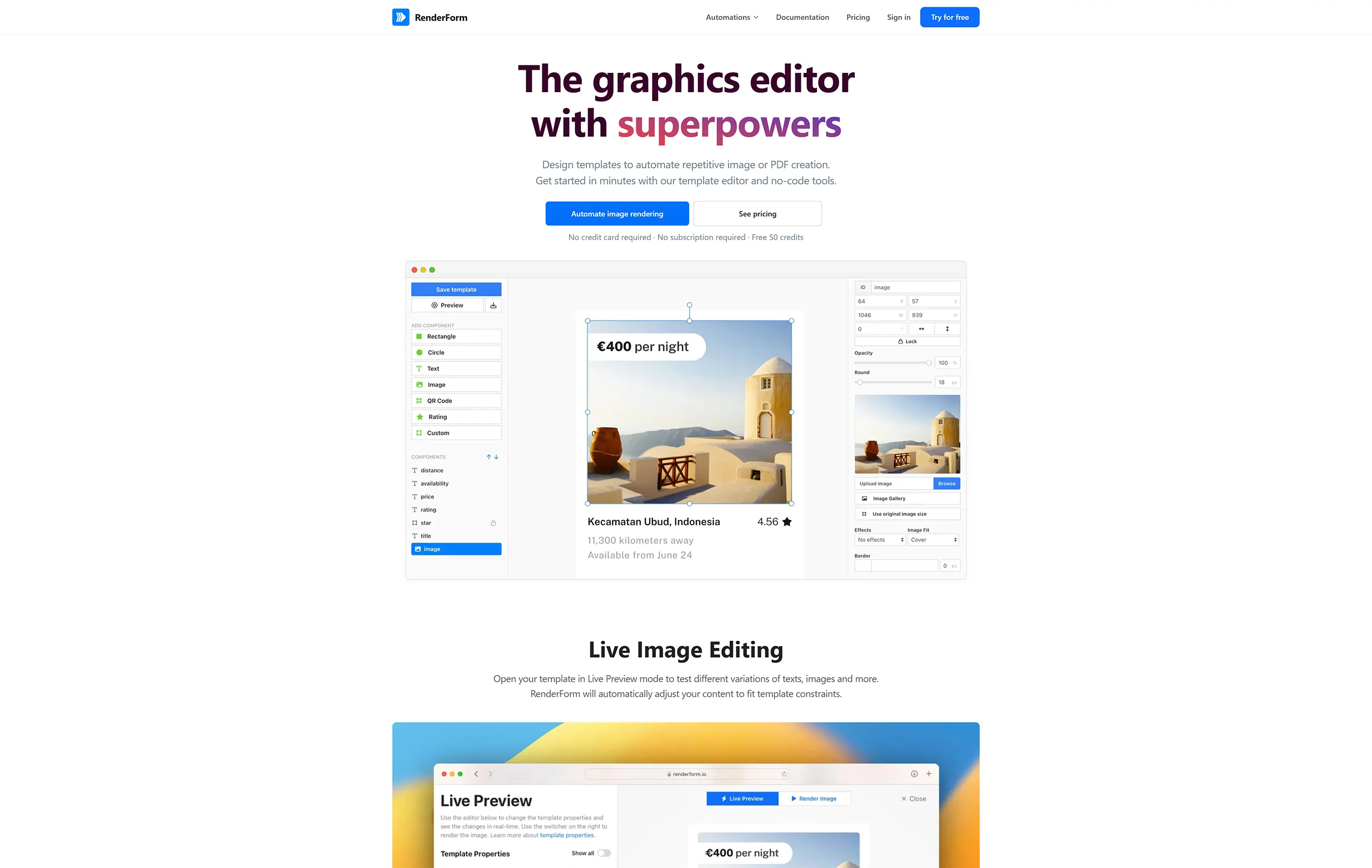
RenderForm is a low-cost option for teams that want to experiment with programmatic image generation without making a significant initial investment. It focuses on automated image creation from templates and can be useful for common use cases such as social graphics, personalized marketing images, and other data-driven visual content.
Its free tier lowers the barrier to testing the concept before paying for an image-generation API. The trade-off is that free generated images include watermarks, so the free plan is primarily useful for evaluation rather than production use. Paid plans remove the watermarks.
For small teams, startups, or developers validating an image automation workflow, this low-cost entry point can be more important than having an extensive set of advanced features.
10. Pixelixe
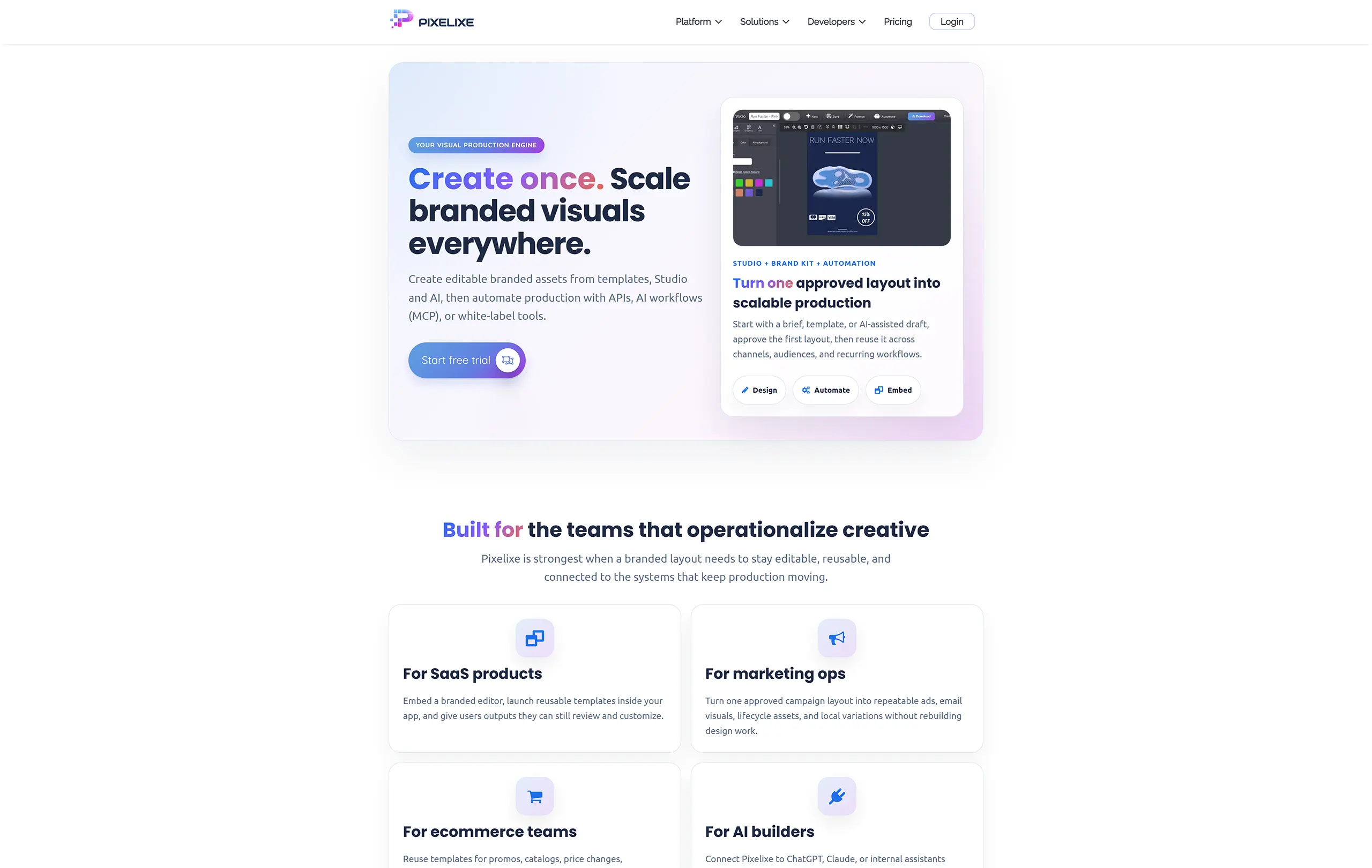
Pixelixe focuses on high-volume automated image creation, particularly for social media, marketing, and e-commerce use cases. Its higher-tier plans support large numbers of document renders, making it potentially attractive when the primary goal is producing thousands of visual variations at a low effective cost per image.
The platform also offers white-label capabilities, which can be useful for businesses that want to provide automated image generation to their own customers without exposing the underlying service.
Compared with developer-first platforms such as DynaPictures or Bannerbear, Pixelixe is more oriented toward marketing workflows and less toward deep API-driven application development. Its output-format selection is also narrower, which can matter for teams that need formats such as PDF, PPTX, AVIF, or animated GIF alongside standard images.
Which Templated Alternative Is Right for You?
The best Templated alternative depends on what you’re trying to solve. If the main problem is Templated’s Starter plan limits, look for a platform that doesn’t restrict your template library or team size. If you’re replacing an existing design workflow, Canva or Figma import may matter more. And if you’re building image generation into a product, API speed, white-label options, and pricing at scale become more important.
Here’s the short version:
- Need unlimited templates and team members: DynaPictures
- Need Canva and Figma import: Orshot
- Want a low-cost no-code option: Placid
- Need agency campaign and approval workflows: Abyssale
- Need advertising production and publishing: Creatopy / The Brief
- Need programmatic video: Creatomate
- Want HTML/CSS-based image and PDF generation: APITemplate.io
- Want a mature developer-focused API: Bannerbear
- Want the cheapest way to test image automation: RenderForm
- Need high-volume social and e-commerce image generation: Pixelixe
If Templated’s 15-template or 2-user Starter limits are already getting in the way, DynaPictures is worth testing before moving to a more expensive platform. You can start any paid plan for 14 days without a credit card.
Try DynaPictures as a Templated Alternative
DynaPictures gives teams room to scale their image generation without putting artificial limits on templates or team members. You get API access, AI image generation, a white-label editor, fast synchronous rendering, and specialized features such as countdown timers and personalized event banners.
Try DynaPictures for 14 days for free and see how it fits your workflow.
