

TL;DR
DynaPictures, Gleanin, Attendir, Premagic, InGo, Snöball, Go Spread, and LiveDab all sit in the same category: platforms that help event organizers turn their speakers, sponsors, exhibitors, and attendees into a natural, organic promotion channel, using the social reach those people already have to bring in more attendees and strengthen the event’s brand.
Gleanin, Attendir, Premagic, InGo, and Snöball run that advocacy campaign for you, and most charge $400 to $36,000 or more a year for it.
DynaPictures takes a lighter, self-serve approach to the same goal, automating the part that usually slows everyone else down: producing the branded visuals. An organizer builds one or more branded templates, then hands each speaker, sponsor, exhibitor, and attendee a personal link to generate and share their own version right at the moment they are most likely to do it. No design queue, no login required, with per-share tracking built in.
Gleanin packs many features: 17+ sharing channels, facial-recognition headshot cropping for speaker and sponsor assets, and referral-tracking analytics with native Cvent and Bizzabo integrations. That breadth comes at a matching price: its own pricing page currently lists the entry plan at €439 per month, with a 14-day trial and a one-month minimum commitment, and campaign setup still runs through the organizer rather than a fully self-serve link. Most teams end up paying for coverage and tracking depth they won’t use.
DynaPictures’ pricing starts at €39 per month with a 14-day trial on every plan. It isn’t just a cheaper Gleanin. It’s a self-serve, flexible tool built for the same job, with everything you need and none of the enterprise features or their price tags that most teams never end up using.
Now, we’ll break down all seven Gleanin alternatives below.
Event Marketing Alternatives to Gleanin
DynaPictures
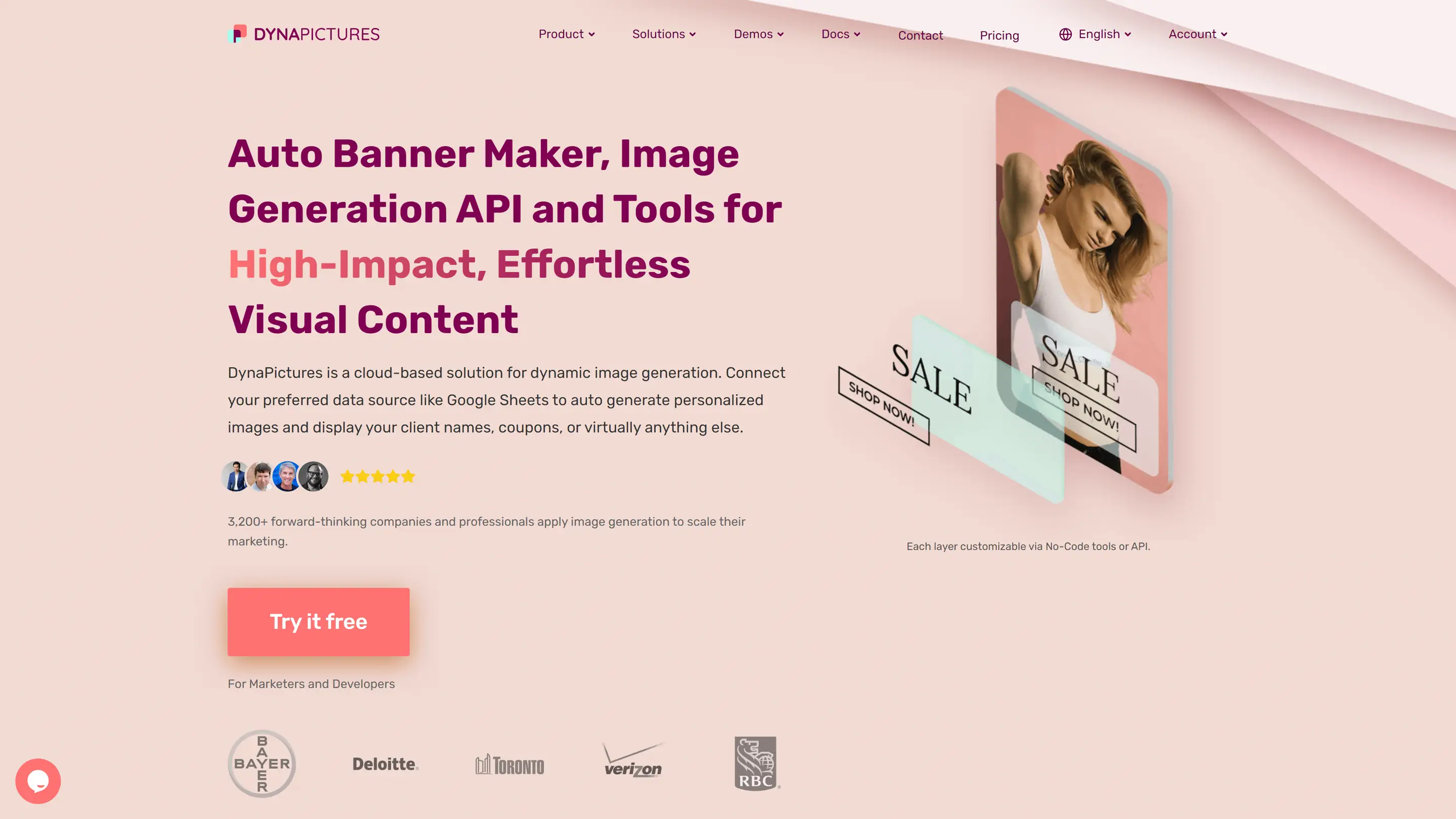
DynaPictures helps event organizers put the social reach of their speakers, sponsors, attendees, volunteers, and other participants to work promoting the event naturally, bringing in more attendees and reinforcing the event brand along the way. It does that by automating the part that usually gets in the way: producing enough branded, on-guideline visuals fast enough for people to actually share.
- Build the template once
An organizer designs one branded template per audience (speakers, sponsors, exhibitors, attendees) and locks the elements that shouldn’t change: logo, colors, event name, layout. That happens once per event, not once per person.
- Let speakers generate their own banner
When a speaker confirms, they get a personal link in the same confirmation email, not a separate ask that lands on a to-do list weeks later. They open it, upload a headshot, and get back a banner already sized for LinkedIn, already carrying the event’s name and dates, already matching the brand guidelines the organizer set. No design brief, no waiting on a design queue.
- Extend the same system to sponsors, exhibitors, and attendees
The mechanic repeats with the fields each audience needs: sponsors get their tier and logo populated automatically, exhibitors get their booth number, and attendees get a banner the moment they register through a widget on the confirmation page. Each group gets its own link and its own tracking.
Exhibitors in particular tend to be the most underused version of this. The Center for Exhibition Industry Research calls exhibitor invitation programs organizers’ “lowest collaborative hanging fruit” for registration growth: exhibitors already have the customer lists and industry audiences that would fill the room, and the usual gap isn’t willingness, it’s that most events hand them a logo pack and a line that says “feel free to share,” instead of a ready, personalized asset with their booth number already on it.
- Promote the event at every stage, not just once
One template doesn’t have to mean one banner. Because generating a new version takes the same few clicks regardless of when it happens, the same system can produce a save-the-date, a speaker announcement, a registration-open push, a countdown, a live-event post, and a post-event recap, each reusing the template with different data instead of a new design pass. That’s the difference between one generic graphic per event and a full promotional sequence, without new design work for each step.
This isn’t a niche idea DynaPictures is betting on alone. Premagic’s own product now includes “Memory Banner” posters that automatically pull a returning attendee’s photos from a prior edition into a personalized recap graphic, timed to build anticipation before the next event opens for registration.
Different mechanism, same underlying logic: a template built for one moment in the event lifecycle can be reused for the next one, and organizers who only ever produce one banner per event are leaving that reuse on the table.
- Track what actually worked
Every share gets its own tracked link, clicks are bot-filtered so the numbers hold up, and results, including registrations and revenue where it applies, can be attributed back to the person who shared, by channel and by event. That reporting layer is the piece most of the lighter self-serve tools in this comparison, including Go Spread and LiveDab, don’t offer. It’s what lets an organizer measure the campaign’s actual ROI rather than estimate it, and show a budget meeting exactly which speakers, sponsors, and exhibitors drove the most registrations, not just how many banners got made.
Giving someone a professional, on-brand asset at the exact moment they’re already motivated to share, right after confirming, right after registering, gives them a meaningfully better shot at becoming an active distribution channel than asking them to make time for a design request later.
That’s a claim about removing friction and Premagic’s own reporting attributes up to a 40% lift in session registrations to speaker-driven campaigns specifically. Nielsen’s long-running trust research puts peer recommendations at 88 to 92% trust versus other forms of advertising, both consistent with why closing that production gap is worth the effort.
Starting price is €39 a month, 14-day trial, and no credit card required → Try for free.
Attendir
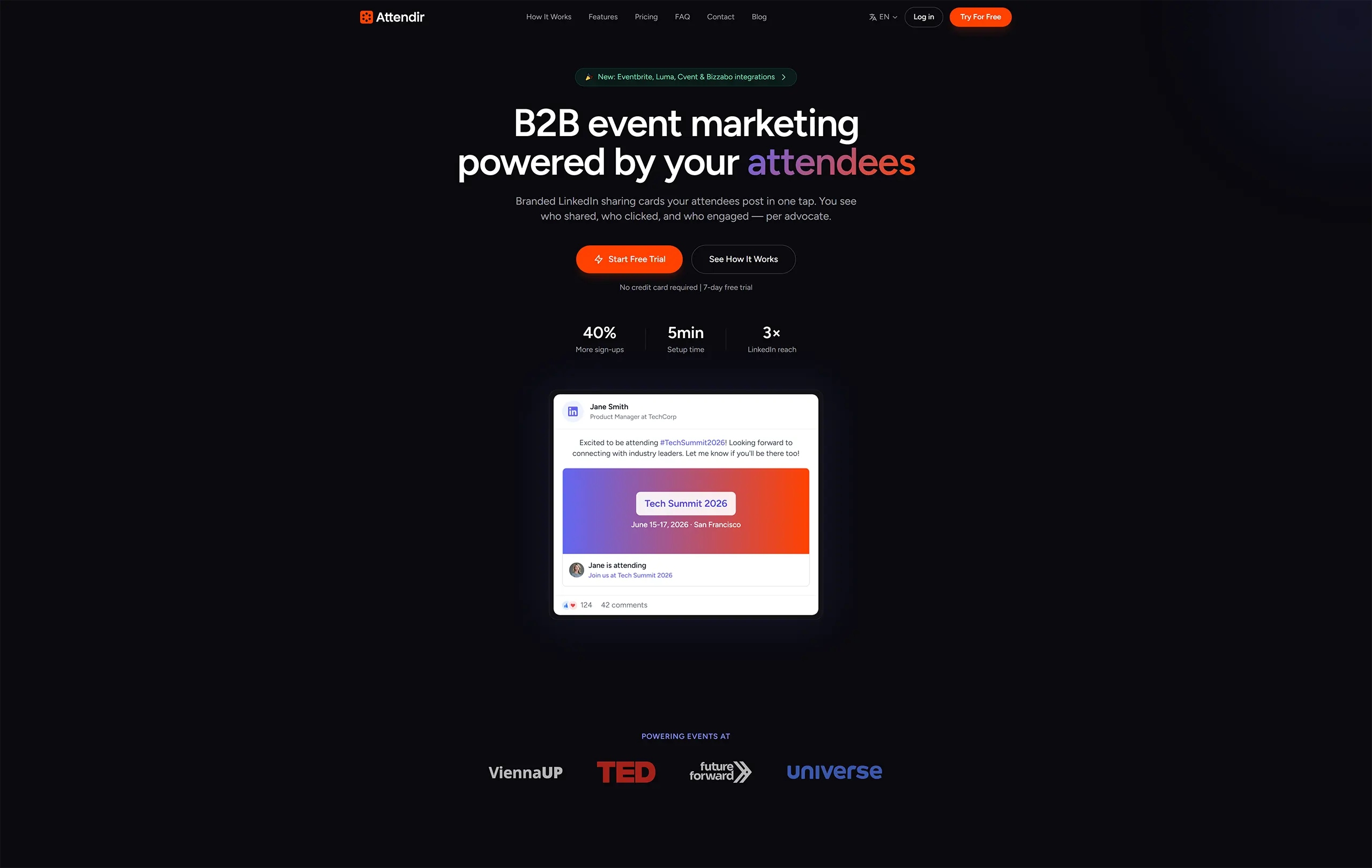
Attendir is self-serve and built around LinkedIn first, but it isn’t LinkedIn-only: its plans include sharing to X, Facebook, and WhatsApp alongside LinkedIn, plus per-advocate click and conversion tracking and native integrations with Eventbrite, Luma, Cvent, and Bizzabo. It’s faster to set up than Gleanin, which is a real advantage, but at €329 to €991 a month it’s still priced like an enterprise advocacy platform, and its per-advocate analytics are built for teams that want to report at that depth.
Premagic
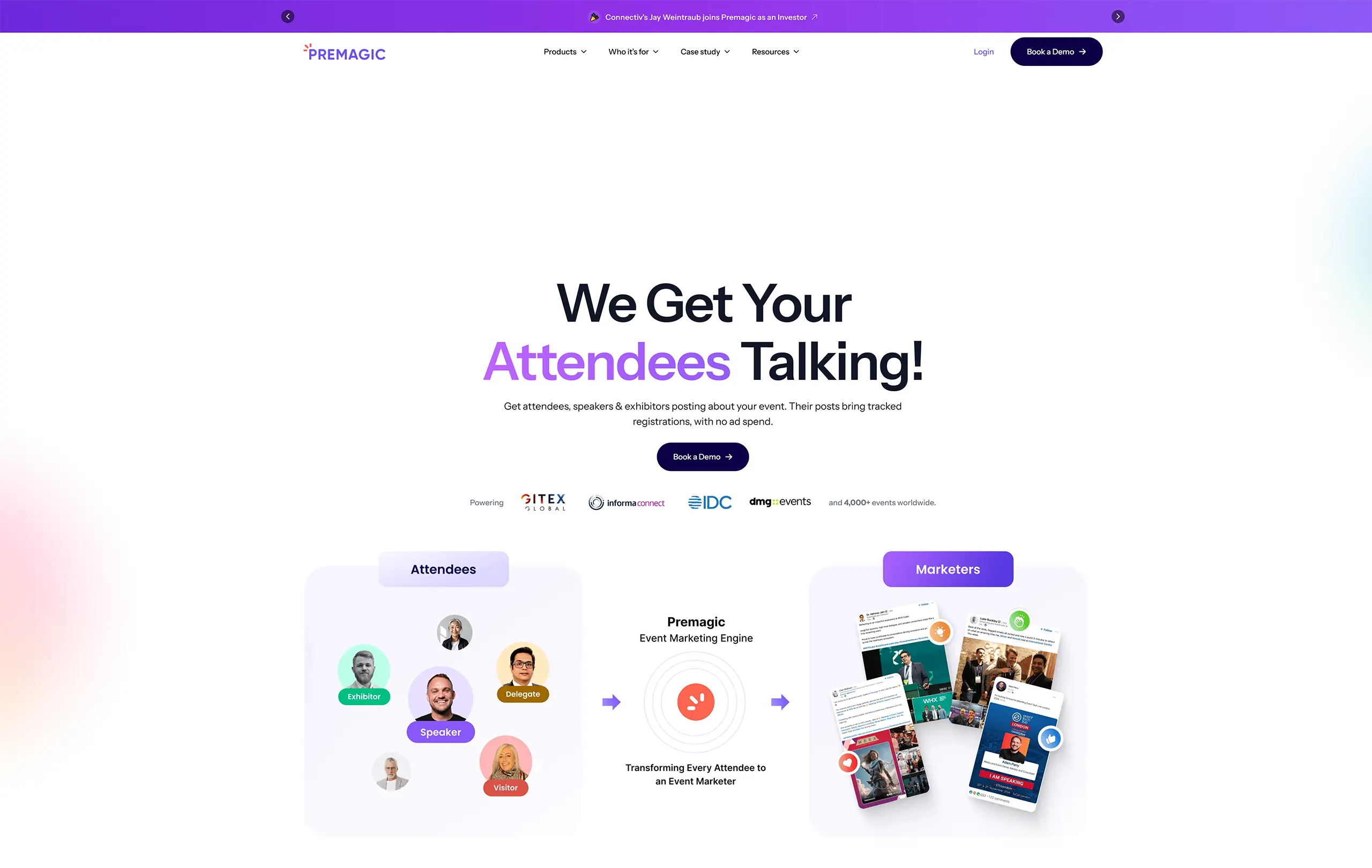
Premagic leans into AI: automatically matching and distributing event photos to attendees during the event via facial recognition, plus a drag-and-drop poster editor, an avatar studio, and sponsor-visibility reporting. According to its own FAQ, campaign setup is genuinely self-serve. What they mean is that an organizer can launch a campaign in about 15 minutes.
Also, it offers a managed option where Premagic’s team designs and runs the campaign alongside the organizer’s own team, similar in spirit to Snöball’s model but layered on top of self-serve software rather than replacing it.
What still isn’t published is price: there’s no public rate card, and a demo is required to get a quote. Its case studies (GITEX Global 2025: 200,000 attendees, 16,185 advocacy posts, and a reported $219K in ad-spend savings; Khaleej Times Events: 80 active advocates driving 700 referrals) point to a platform built for large trade shows and corporate events more than a single independent conference.
InGo
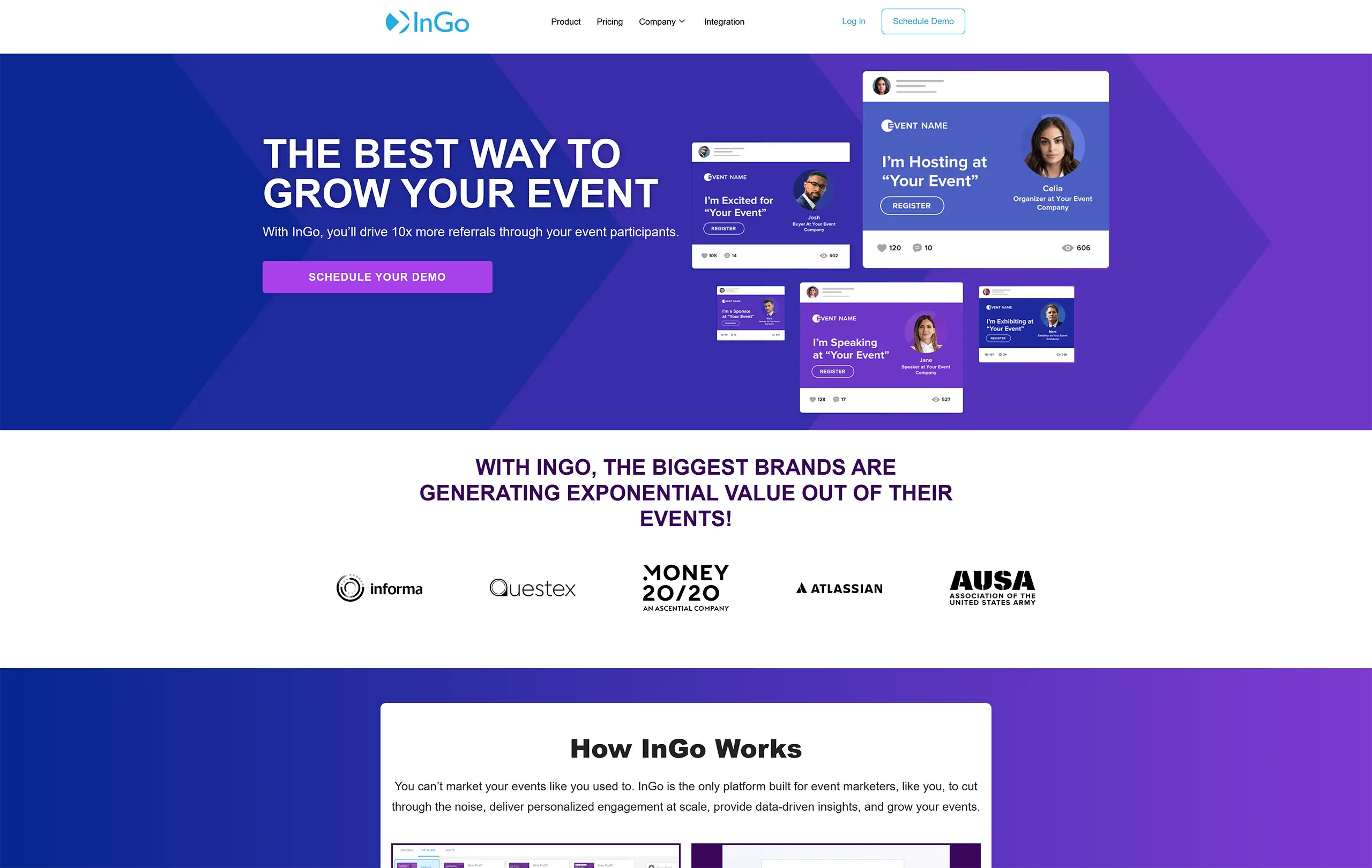
InGo is the most enterprise-skewed platform in this comparison, using LinkedIn social-graph analysis to target referral campaigns for large-scale registration drives. Its own site doesn’t publish specific supported channels or a self-serve signup, routing everything through a demo request, and third-party estimates put annual pricing at alleged $18,000 to $36,000. But ultimately, you should send an individual to learn the actual pricing. Clients like Atlassian and Money 20/20 suggest this is built for large marketing teams running major campaigns, not independent organizers.
Snöball
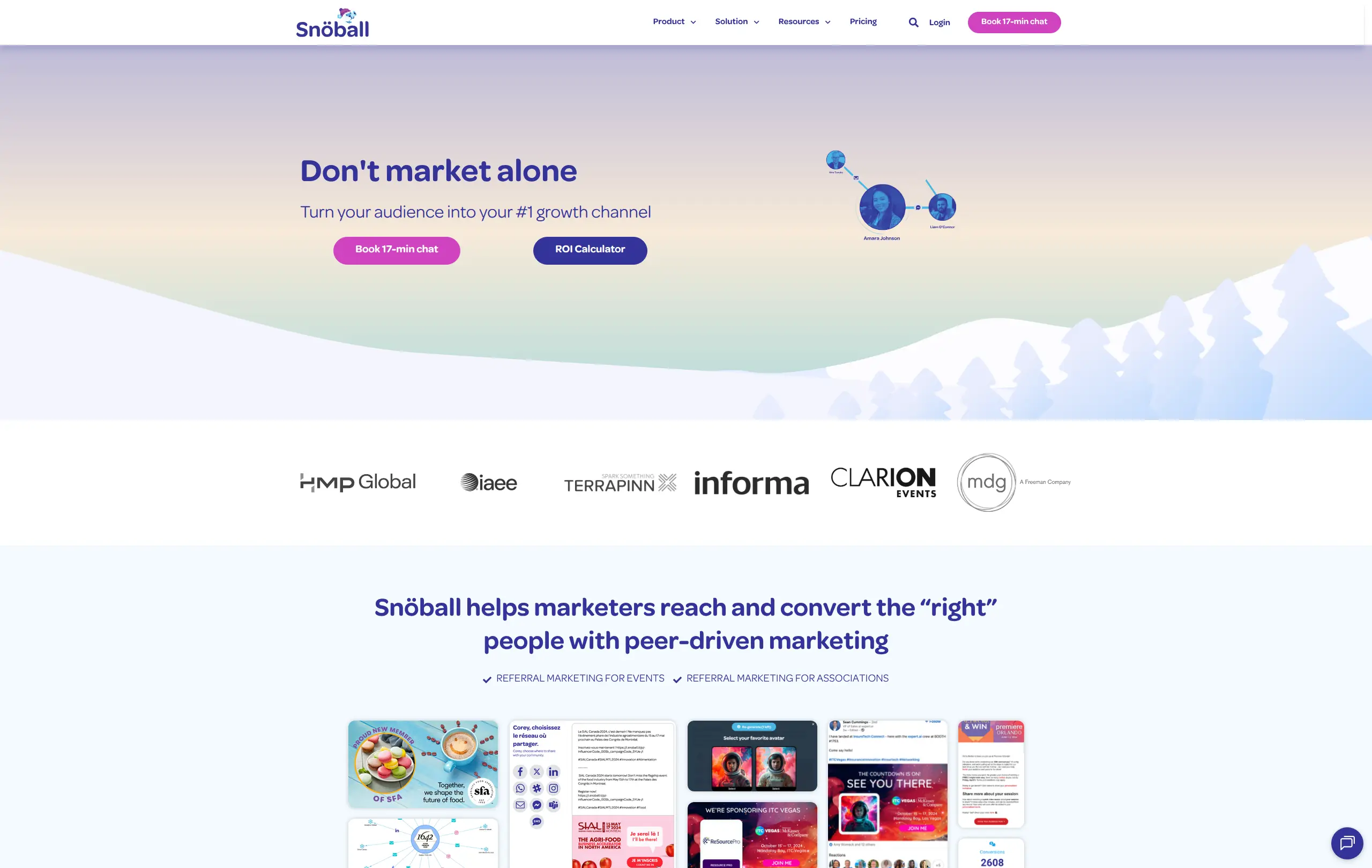
Snöball takes a different approach entirely: instead of self-serve software, a team is buying a managed campaign with a dedicated team running it for them. That’s genuinely appealing without the internal resources to run an advocacy campaign in-house, but it starts at $5,497 per project, a different budget conversation than a monthly subscription, and it depends on their team’s schedule rather than a timeline the organizer controls.
Go Spread
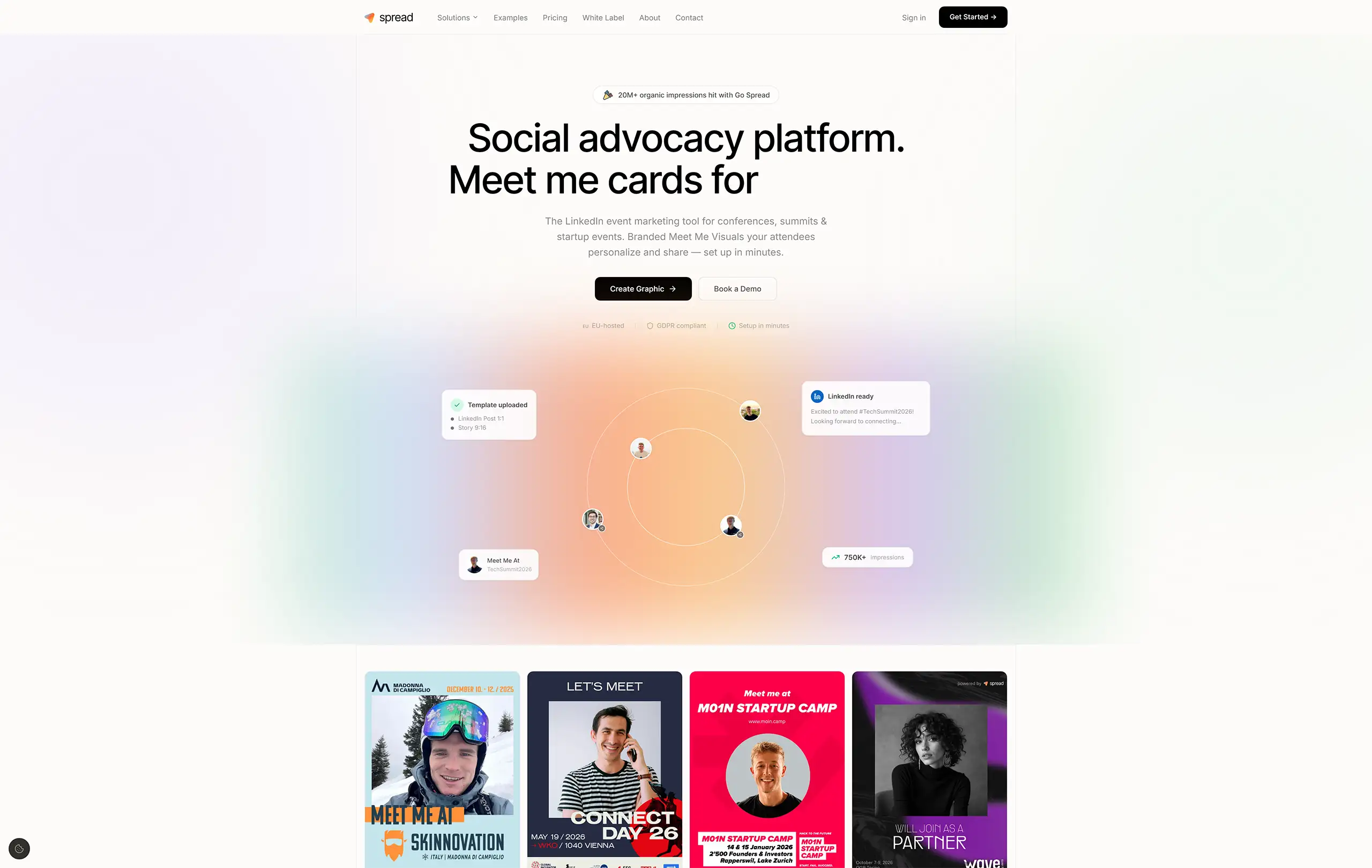
Go Spread is the closest in spirit to a lightweight tool: no-login LinkedIn visuals, EU-hosted for GDPR compliance, and a free tier for up to 15 participants. Its cheapest paid plan is €79 one-time for up to 250 participants (valid for four months), making it one of the lowest-cost self-serve options in this comparison. The tradeoff is scope: each paid plan is capped to a participant count and a single event window, so a team running events continuously will be repurchasing access more often than with a subscription.
LiveDab
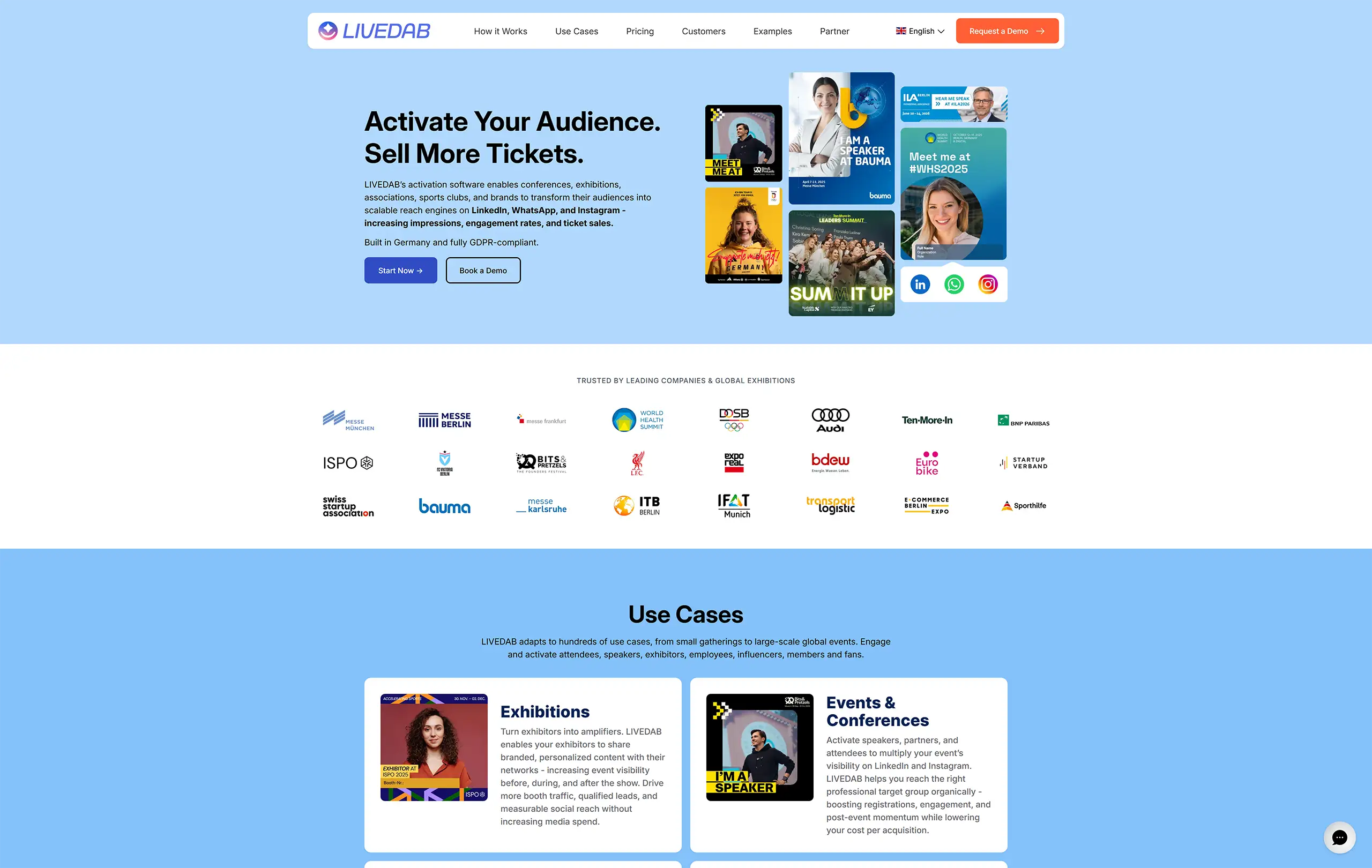
LiveDab skips subscriptions in favor of one-time credit packs, from €499 for 150 credits up to €2,999 or more for unlimited, which suits associations and sports clubs running a handful of events a year rather than a continuous program. The tradeoff is that credits run out: if advocacy becomes a standing part of how a team promotes every event, they’re repeatedly re-buying access instead of paying one predictable monthly rate.
Gleanin Alternatives Comparison
| Platform | Best for | Self-serve | Primary channels | Tracking | Starting price |
|---|---|---|---|---|---|
| DynaPictures | Teams who need the easiest self-service with branded content for speakers, sponsors, exhibitors and attendees to share | Yes, no login | Native share sheet: LinkedIn, Instagram, WhatsApp, X, plus direct download | Per-share tracked links, click and revenue attribution | From €39/mo |
| Gleanin | Enterprise event marketers wanting the widest channel coverage | Yes | 17+ channels | Referral tracking analytics | From €439/mo |
| Attendir | B2B conferences prioritizing LinkedIn reach with wider channel backup | Yes | LinkedIn, plus X, Facebook, WhatsApp | Per-advocate click and conversion tracking | From €329/mo |
| Premagic | Large trade shows wanting AI photo distribution plus full-lifecycle advocacy | Yes, self-serve setup (~15 min per their FAQ); pricing still requires a demo | LinkedIn, email, WhatsApp, plus direct download and embed | Per-advocate reporting; referral link and promo-code attribution | Demo-only pricing |
| InGo | Enterprise organizers running large-scale registration or referral campaigns | No, sales/demo-led setup | Not publicly specified | Analytics dashboard | Upon request |
| Snöball | Teams that want a managed or outsourced campaign | No, fully managed | Multi-channel (managed by their team) | Real-time dashboards | From $5,497/project |
| Go Spread | Lean teams wanting no-login LinkedIn visuals at a low entry price | Yes | LinkedIn-focused | Real-time analytics | €79 one-time, 250 participants |
| LiveDab | Associations preferring credit packs over subscriptions | Yes | LinkedIn, Instagram, WhatsApp | Real-time reporting | From €499 one-time, 150 credits |
Built Lean, by Design
DynaPictures is deliberately lean. It’s self-serve software, not LinkedIn social-graph targeting like InGo, a managed campaign team like Snöball or Premagic’s execution add-on, or a suite of native enterprise integrations like Gleanin’s Cvent and Bizzabo connections. That’s by design: teams that need a specialist team running their advocacy strategy, or the enterprise integrations that come with it, are better served by one of those three, at an enterprise price to match. Everyone else gets the core of what actually moves the needle: self-serve banners in the hands of the people who’d share them, without paying for the parts of the platform they’d never touch.
Photos work on the same self-serve logic: each speaker, sponsor, or attendee uploads or picks their own photo into a designed template, rather than depending on a photographer or facial-recognition matching on-site. That has real advantages of its own: it works for virtual and hybrid events with no camera hardware needed, it doesn’t require processing biometric facial-recognition data (a genuine GDPR consideration, since facial recognition falls under special-category data with its own consent and impact-assessment requirements), and it gives the person being represented a say in which photo goes out under their name, rather than whichever frame a camera happened to catch.
DynaPictures is built for an event team that already knows what its creative should look like and needs speakers, sponsors, and attendees to be able to act on that without waiting on design resources.
What Event Marketing Platforms Have in Common and Where They Differ
DynaPictures, Gleanin, Attendir, Premagic, InGo, Snöball, Go Spread, and LiveDab overlap around one core idea: your speakers, attendees, sponsors, and exhibitors can become an additional distribution channel for your event.
Beyond that, they differ substantially. Premagic layers in AI photo distribution and event engagement tools most of the others don’t touch. Snöball sells a managed campaign, not software you operate yourself. InGo leans on LinkedIn social-graph targeting for large registration drives. Gleanin bundles the widest channel coverage and native integrations with Cvent and Bizzabo.
How much of that breadth an event team needs, versus how much they’d be paying for capability they won’t use, is the real question this comparison is trying to answer.
For many event organizers and event marketing teams, the problem isn’t getting people to promote your event. It’s producing enough content for them to promote.
Your speakers, sponsors, and attendees are already one of your event’s strongest distribution channels. They have audiences you don’t have to buy reach for.
The bottleneck usually isn’t willingness. It’s production.
A typical event team builds a speaker banner manually, sends it over, and repeats that process for every speaker, sponsor, and exhibitor on the list. Add a save-the-date graphic, an “I’m speaking” banner, a countdown, a “we’re live” post, and a post-event recap, and one event can call for dozens of variations.
Most teams don’t have the design hours for that, so they produce fewer assets than they could, speakers get fewer things worth sharing, and the event gets less exposure from audiences it already had access to.
That’s the specific gap DynaPictures is built to close, and it’s a different gap than the one Gleanin, Attendir, Premagic, InGo, and Snöball are built around.
Which Gleanin Alternative Is Right For You?
Choose DynaPictures if you already have your event branding and want speakers, sponsors, exhibitors, and attendees to generate their own promotional assets from a template you control, with tracking attached.
Choose Gleanin if you need a mature, multi-channel event advocacy platform with broad campaign management and native event-platform integrations, and the budget for it.
Choose Attendir if LinkedIn is your primary channel, self-serve setup matters, and you want per-advocate tracking without Gleanin’s full price.
Choose Premagic if event photo distribution and AI-driven attendee engagement are central to your strategy, not just banners.
Choose InGo if you’re running large-scale registration or referral campaigns and want a team applying social-graph targeting on your behalf.
Choose Snöball if you’d rather hand the campaign to a managed team than operate another piece of software.
Choose Go Spread if you want the lowest-cost self-serve option and your events are LinkedIn-focused with a capped participant count.
Choose LiveDab if you prefer paying in credit packs over a subscription and run events occasionally rather than continuously.
Summary
Every platform in this comparison agrees on one thing: the people at your event will help promote it if you make that easy enough. Where they differ is what “easy enough” costs, and what kind of easy it solves for.
Gleanin, Attendir, Premagic, InGo, and Snöball solve for running the advocacy campaign itself, with price tags that range from a few hundred dollars a month to tens of thousands a year. Go Spread and LiveDab get closer to lightweight, at the cost of either tracking depth or a subscription model. DynaPictures takes the lightest path to the same goal: producing enough on-brand content, fast enough, for the people who’d share it, at a fraction of the entry price of the platforms built around running the bigger campaign.
Create your event template once. Let every speaker, sponsor, and attendee generate their own banner → Start free
Frequently asked questions
DynaPictures is the best Gleanin alternative if you’re looking for the lowest-cost starting points, with DynaPictures’ paid plans beginning at €39 per month. The right comparison depends on whether price alone is the deciding factor or what’s included: DynaPictures adds per-share tracking and attribution that Go Spread’s entry tiers don’t.
No. Gleanin’s pricing page lists a 14-day free trial but no permanent free tier. Its entry plan currently starts at €439 per month on a yearly plan. DynaPictures offers a lower entry plan at €39 per month or $20 for 1,000 credits, which are enough to make approximately 250 images.
Platforms like Gleanin, Attendir, InGo, and Snöball bundle campaign management, targeting, or managed services around the sharing mechanic, and are typically priced and sold accordingly. A self-serve tool like DynaPictures focuses on removing the production bottleneck: letting each speaker, sponsor, or attendee generate their own on-brand asset from a template, with tracking attached, without the broader campaign infrastructure. Which one fits depends on whether the harder problem is running a campaign or producing enough content for one.
Yes, on most of the platforms compared here, including DynaPictures, Attendir, Premagic, Go Spread, and LiveDab, the person sharing opens a link, personalizes a template, and shares directly, without an account or download. InGo’s participant-facing flow isn’t fully documented on its own site, and Snöball’s process runs through their managed team rather than a self-serve link.
