


General Overview
When we first ran the numbers for this article back in 2024, personalization mostly meant segmenting your list and dropping a first name into a subject line. That toolkit doesn’t hold up anymore. Real-time personalization engines, agentic AI campaign tools, and privacy-first data platforms have all reshaped what “personalized marketing” actually takes to pull off in 2026.
What hasn’t changed is the gap between how personalization is supposed to work and how it actually lands with customers. According to Twilio’s 2025 State of Customer Engagement Report, only 45% of consumers feel truly understood by AI-personalized experiences, despite record investment in AI-driven personalization. Marketers are more confident than ever. Customers aren’t feeling it yet.
Statista projected back in 2022 that the customer experience personalization and optimization software market would grow from $7.6 billion in 2021 to $11.6 billion by 2026, an increase of more than 65%. That’s the year we’re in now. Actual 2026 figures aren’t out yet to confirm the market landed exactly there, but the direction was right: personalization has gone from a nice-to-have line item to a core piece of the marketing budget.
Personalized emails can help increase conversions, sales, and ROI. That hasn’t changed either.
There’s more where that came from. Here’s what the latest data says about personalization in 2026. Some of it will surprise you.
1. Does it work? 93% of marketers report that personalization improves leads or purchases (HubSpot).
2. How deep does execution actually go? Only 13% of teams hyper-personalize using data or lookalike audiences, and just 14% personalize or segment at least half their content. Most are still doing the basics: 53% use simple tactics like inserting a name, 47% segment audiences at all. (HubSpot)
3. Belief vs. measurement gap: 63% call personalization a top priority or core to their DNA, but only 54% have clear quantitative KPIs actually tied to that priority. (Mastercard)
4. Where the real bottleneck is: 44% of marketers know their customers’ shopping habits, but that drops to just 16% who know customers’ pain points. (HubSpot)
5. Belief still outruns execution at the org level, too: 96% of organizations believe in the value of personalization, but only 10% have fully aligned around it. 47% haven’t built a real program or quantified impact, 39% have allocated resources but not more, and 4% are still struggling to get buy-in at all. (Mastercard)
6. The perception gap: Only 43% of brand interactions are perceived as personalized by consumers, despite the effort brands report putting in. (Deloitte)
7. Timing matters from day one: 32% of Americans want personalized offers starting with their very first interaction with a brand, 29% would rather wait until after their first purchase, and 25% want to wait until they’ve made a few purchases. (Amperity)
Where Personalization Pays Off
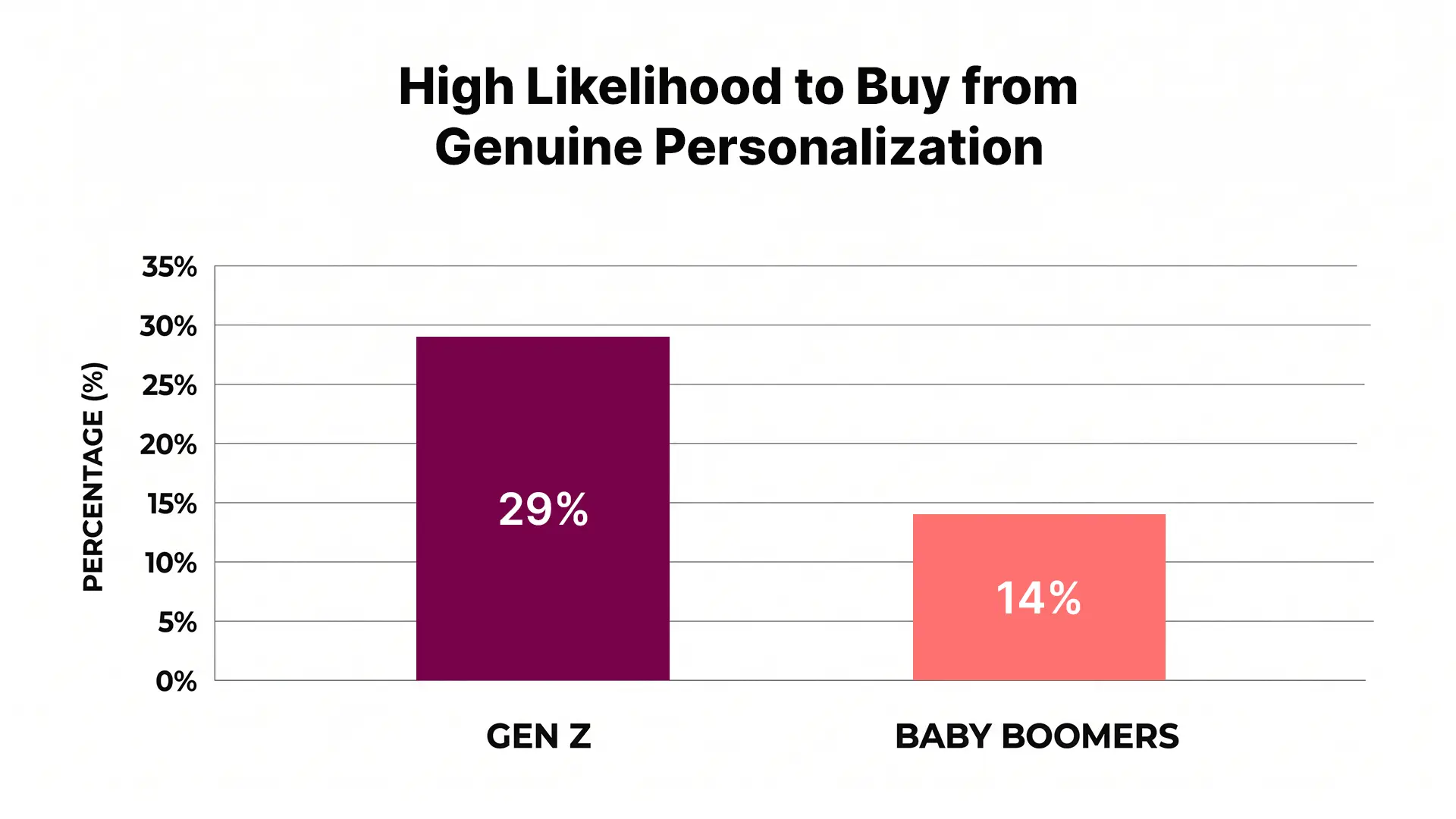
The payoff shows up first at the point of sale. Amperity’s 2026 State of Personalization in Retail report found that 29% of Gen Z shoppers say they’re much more likely to buy when they get a genuinely personalized offer or recommendation, compared to just 14% of Baby Boomers. That’s a real generational gap in how much personalization actually moves a purchase decision.
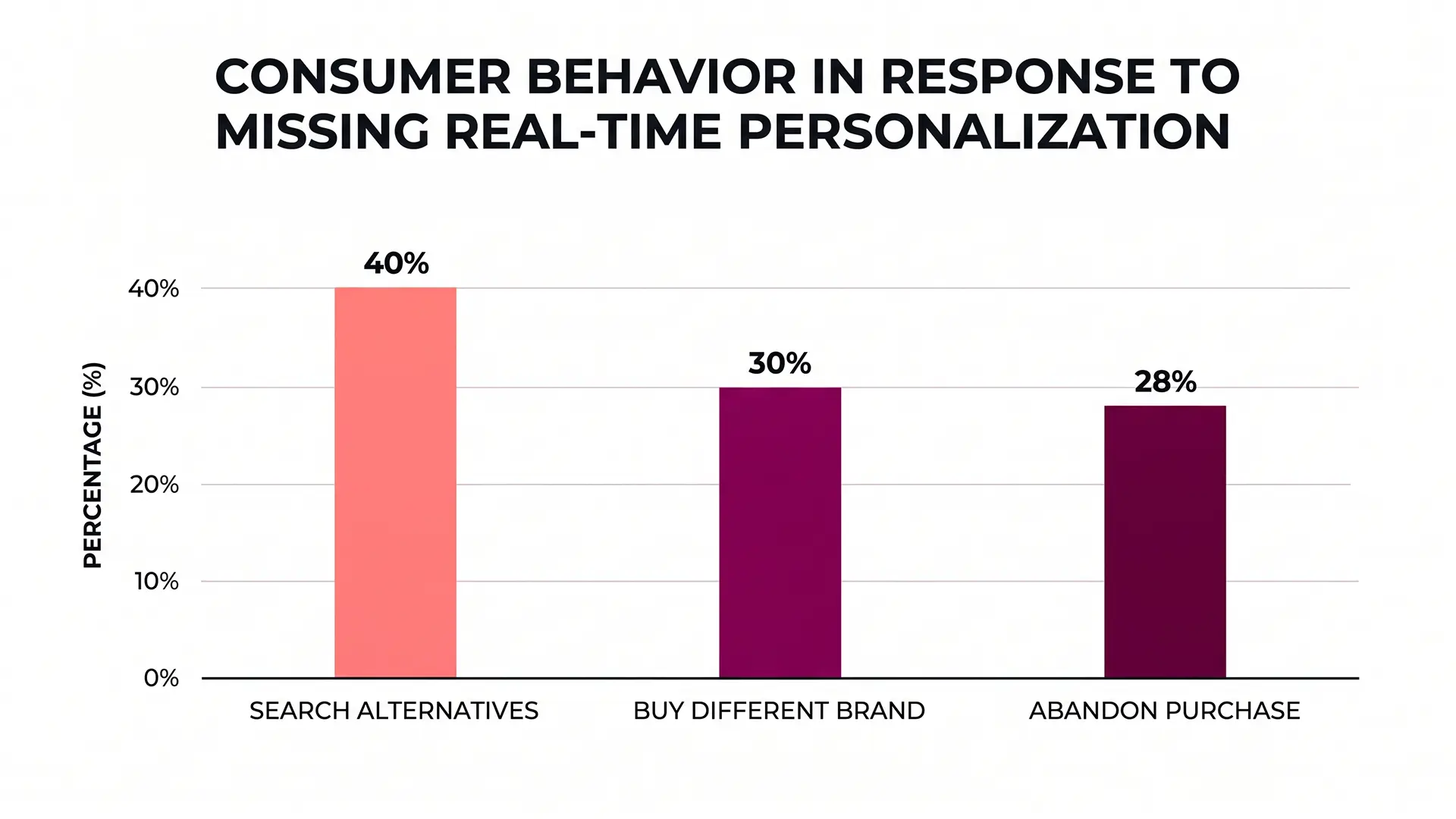
Timing matters as much as relevance. Twilio’s 2025 State of Customer Engagement Report, based on a survey of 7,640 consumers and 637 business leaders across 18 countries in January and February 2025, found that 88% of consumers are more likely to buy when a brand personalizes in the moment, not after the fact, and 35% say they’re significantly more likely to buy. Miss that moment and the cost is immediate: 40% of consumers will search for alternatives, 30% will buy from a different brand instead, and 28% will abandon the purchase altogether.
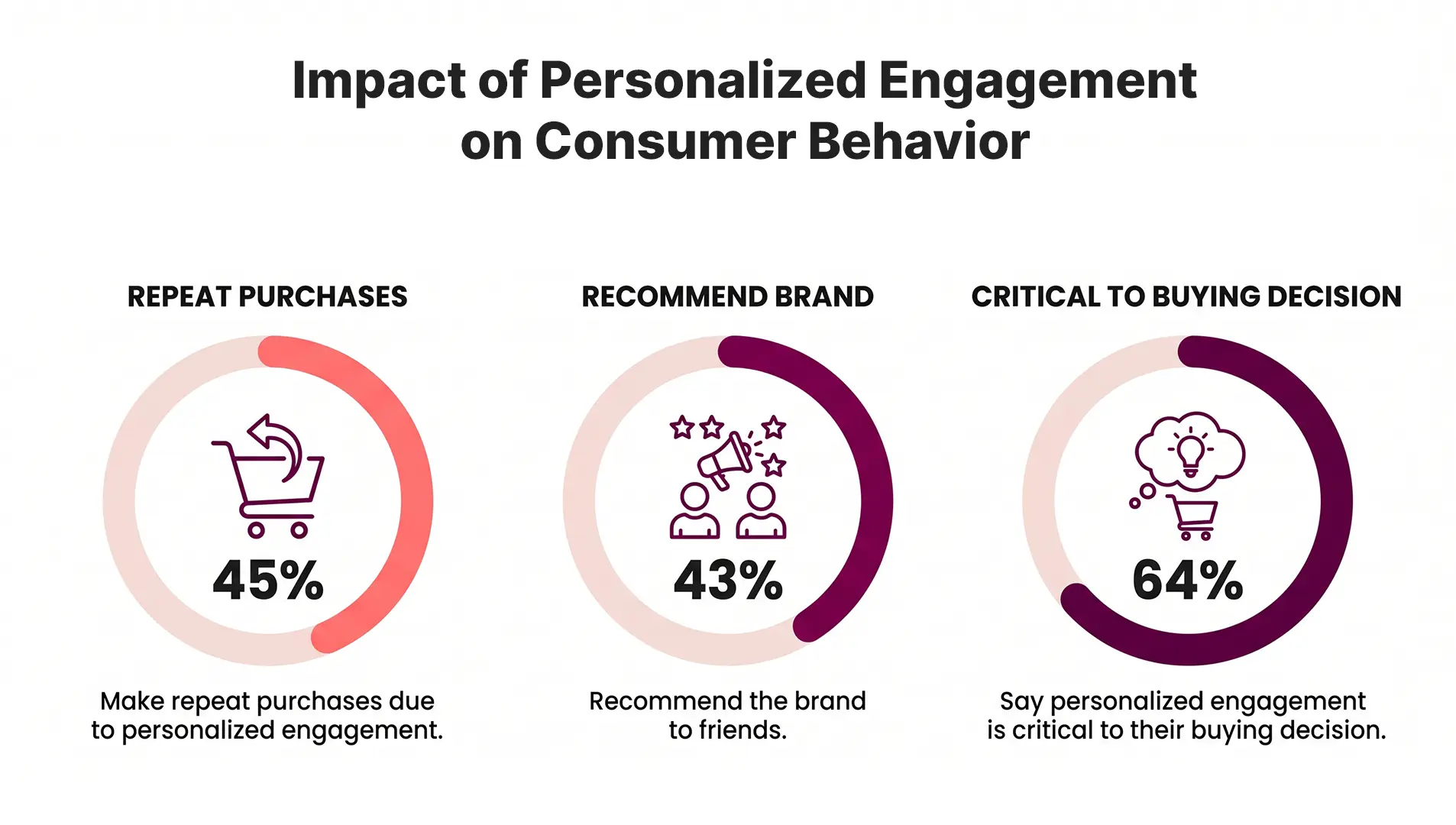
Get it right and the payoff compounds. The same Twilio report found that 45% of consumers make repeat purchases because of personalized engagement, 43% recommend the brand to friends, and 64% say personalized engagement is critical to their buying decision in the first place.
Personalization also pays off in production cost, not just conversion. Deloitte’s Digital Marketing Trends 2026 report found that generative AI has already delivered a 200% increase in copy production capacity and cut manual design time by roughly 60%, while the cost to produce a single marketing image has fallen from around €45 to €4 to €6. That’s the same dynamic behind DynaPictures’ own image generation: once creating a personalized visual costs cents instead of a design sprint, personalizing at scale stops being a budget question.
Email is where this scale question shows up most concretely. Per Litmus, countdown timers are the number one personalization tactic marketers use in email, and they’re also one of the simplest to automate across an entire list rather than building each one by hand.
What Shoppers Want From Personalization
Shoppers aren’t lukewarm about personalization. When it’s done well, they notice, and it changes how they buy.
For 83% of consumers, personalization plays a role in their decision to buy from a brand. It’s not a nice-to-have anymore. It’s a factor in the purchase itself.
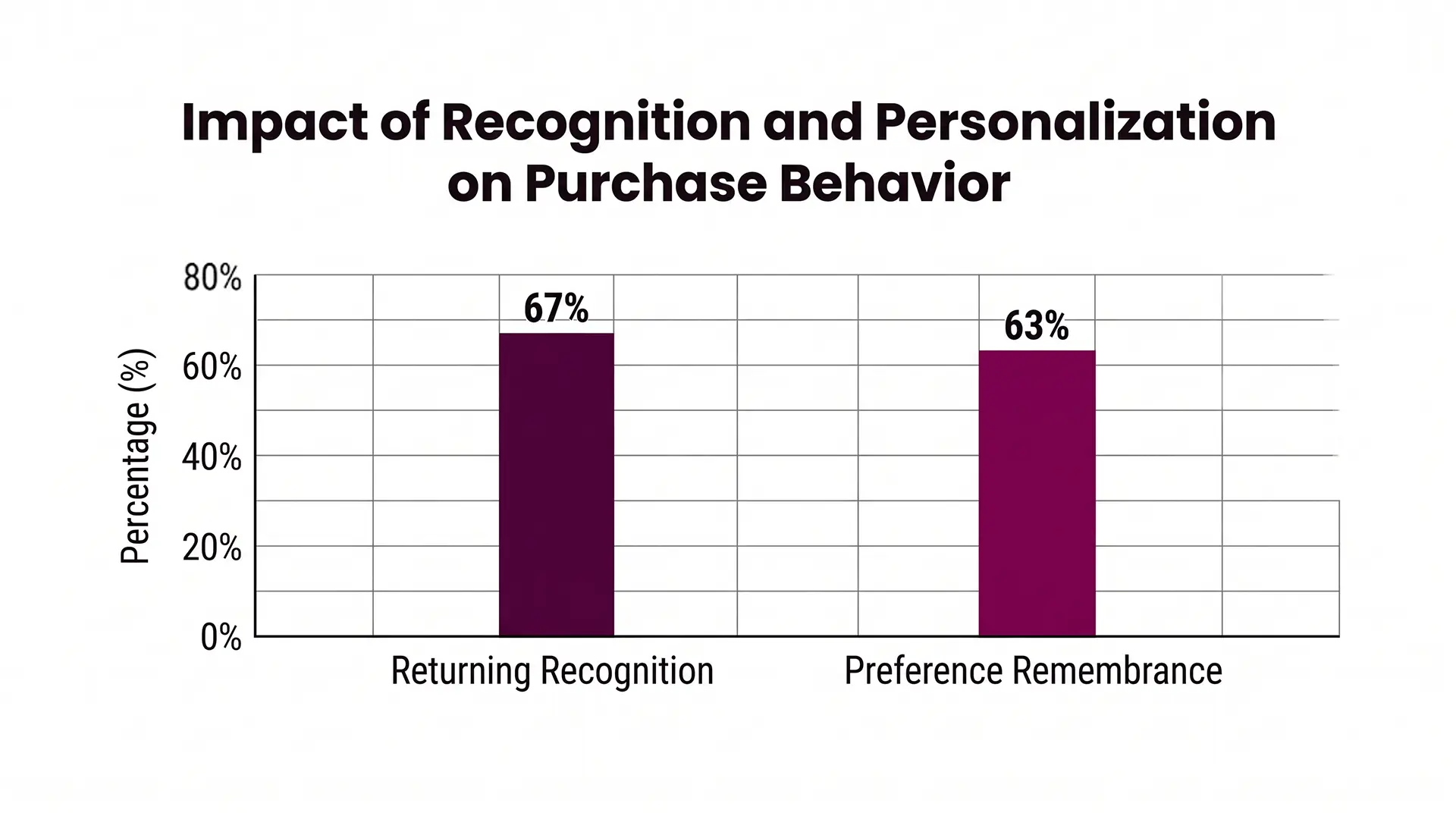
Being remembered matters just as much as being understood. 67% of shoppers say they’re more likely to buy from a retailer that recognizes them as a returning customer, and 63% say the same about a retailer that remembers their preferences from past visits.
That expectation isn’t the same across generations, either. 37% of Gen Z shoppers call personalization “very important” when deciding where to shop, compared to just 12% of Baby Boomers (Amperity). The younger the shopper, the more personalization shapes where they spend.
Loyalty follows the same pattern. 60% of shoppers say personalized experiences make them more loyal to a brand, turning one-time buyers into repeat customers.
Not every channel earns the same trust, either. Email is the channel consumers most want personalized, with 71.2% naming it their preferred channel for tailored offers and content, ahead of text, app notifications, and social media.
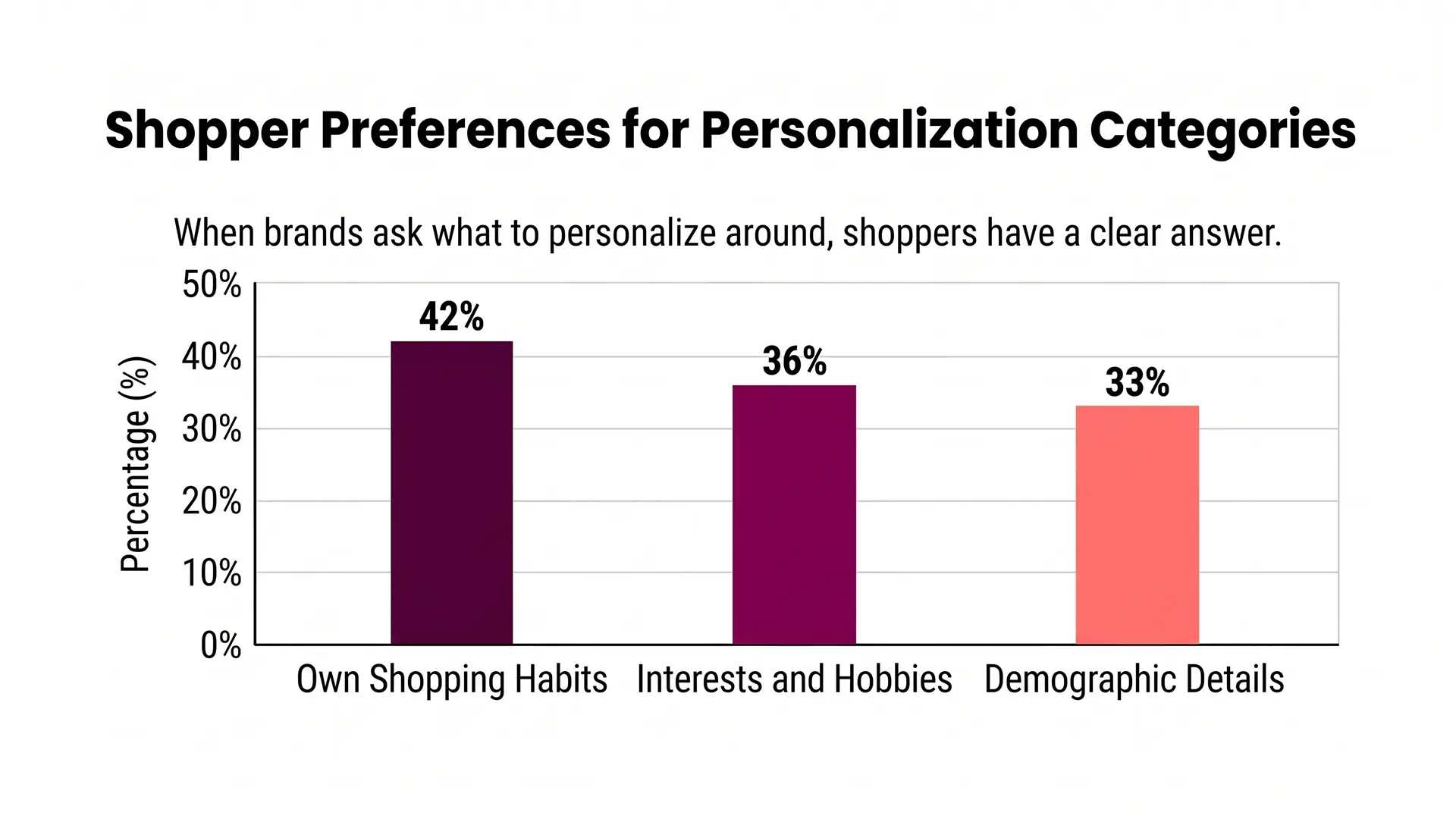
When brands ask what to personalize around, shoppers have a clear answer. 42% say their own shopping habits should shape what they see, followed by interests and hobbies at 36% and demographic details at 33% (HubSpot). Shoppers want personalization to be built on what they actually do, not just who they are on paper.
Relevance and accuracy are what separate personalization that works from personalization that annoys. 67.5% of consumers say relevance is the most important factor in a personalized experience, and 63.8% say the same about accuracy.
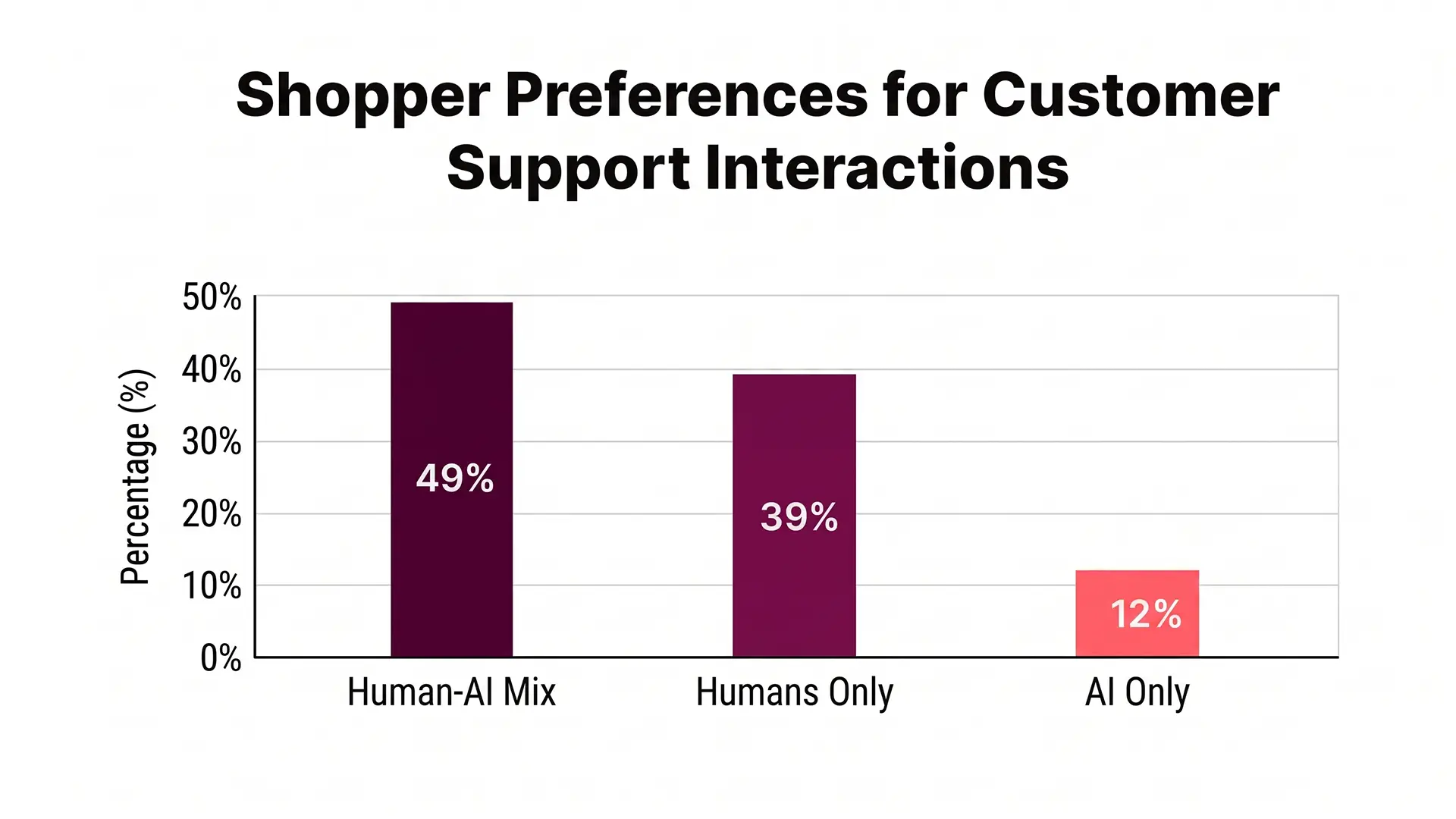
Speed matters, but shoppers don’t want AI running the show alone. 53% of consumers believe retailers should personalize their experience in real time, not days later. When asked how they’d want that delivered, 49% want a mix of human associates and AI assistants, 39% want humans handling it alone, and just 12% want AI to handle it without any human involvement.
That expectation extends to AI specifically. When AI is involved, 28% of shoppers say they feel understood by it, but the number climbs when AI acts on context clues, like a recent purchase or an abandoned cart, rather than static profile data alone (19% vs. 16%, Klaviyo). Consumers respond more to personalization that reacts to what they just did than personalization built on who they’ve always been.
Together, these numbers point in one direction: shoppers want personalization that’s relevant, accurate, built around real behavior, and delivered on the channels they already trust. Getting there is where most brands still struggle, which is what the next sections dig into.
The Trust Gap: Consumers and AI
AI is now doing a lot of the personalization work behind the scenes, and consumers are starting to notice. Not all of it sits well.
21% of consumers say AI-driven personalization feels too personal or intrusive. Right behind that, 14% say the opposite problem: the experience feels overly human-like, in a way that makes them uncomfortable (Klaviyo). Brands are threading a narrow needle. Too much precision reads as surveillance. Too much polish reads as fake.
That discomfort shows up in broader trust numbers too. Only 42% of consumers trust businesses to use AI ethically (Deloitte). Less than half. For a technology brands are betting their personalization strategy on, that’s a shaky foundation.
Taken together, these numbers say something simple: getting the AI right isn’t just a technical problem. It’s a trust problem, and right now brands are on the wrong side of the majority.
The Maturity Gap: Where Execution Falls Short
Customer expectations aren’t waiting for brands to catch up. 67% of customer-facing teams say personalization matters more to their customers than it did a year ago (Salesforce). The demand curve is moving. Whether execution keeps pace is a different question.
Start with people. 54% of organizations now have business, technical, or creative talent supporting personalization, up 4 points from last year. But dig into how that support actually works and the picture thins out fast: only 18% have a dedicated program owner and a support team behind them. Nearly half, 46%, have to pull staff off other priorities whenever a personalization project comes up (Mastercard).
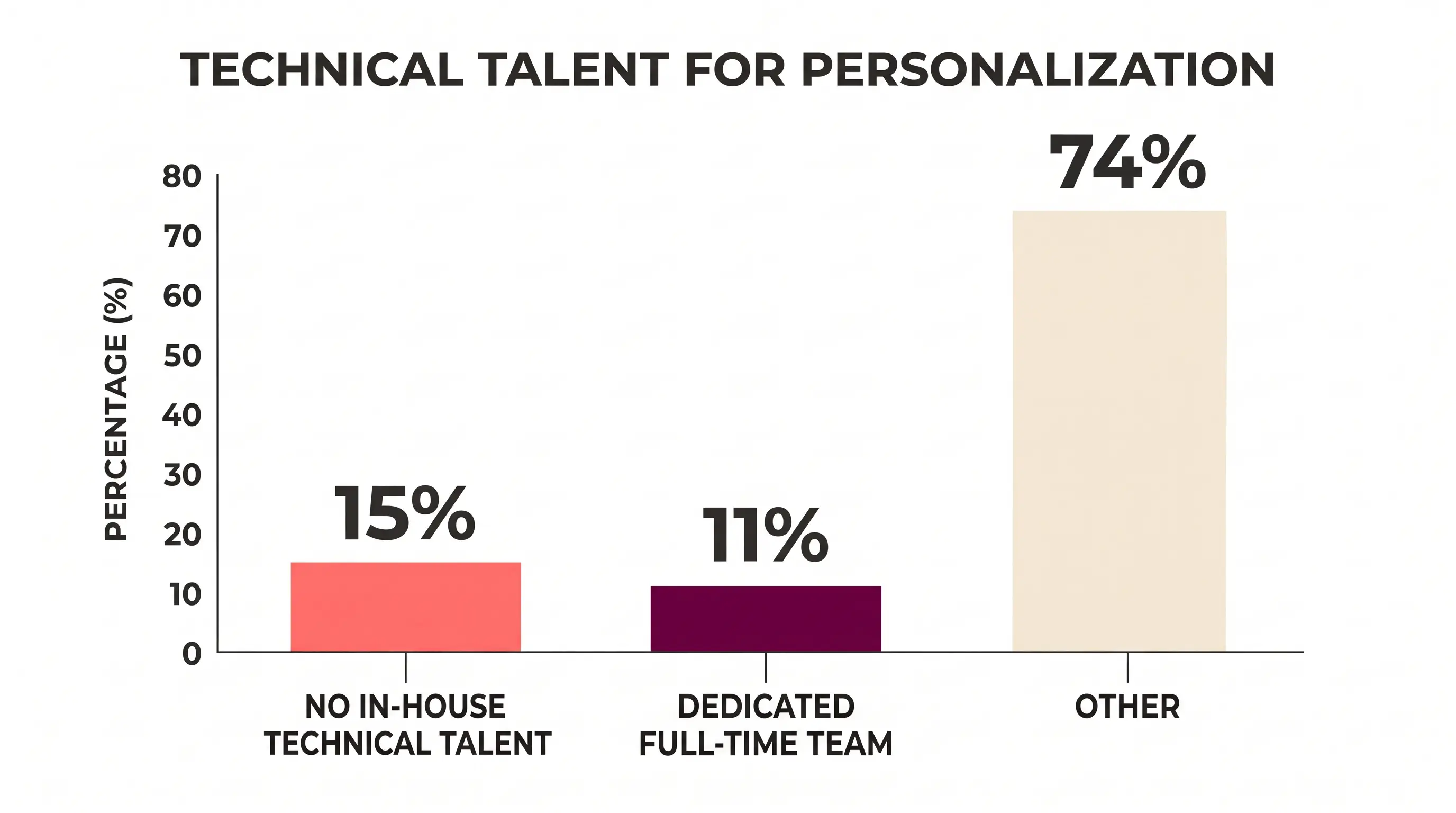
Technical capacity tells a similar story. 53% of organizations report having some form of technical support for personalization, up 12 points year over year. Only 11% have a team dedicated to it full-time, and 15% say they have no in-house technical talent for personalization at all (Mastercard). This is where scale usually breaks down. Getting personalized creative into an email or a landing page shouldn’t require a standing engineering team. DynaPictures generates images and countdown timers in around 200ms and supports batch creation through a spreadsheet, CSV, Airtable, Zapier, or API, so one marketer can produce personalized variations at volume without waiting on a developer for every campaign.
Fragmented data compounds the problem. Among sales and marketing leaders dealing with siloed tech stacks, 33% say the silos have a severe impact on personalization, and another 52% say the impact is at least noticeable (Salesforce). Over 8 in 10 leaders whose data lives in disconnected systems say it’s actively hurting how personalized their outreach can be.
Even brands that have the data don’t always use it. 71% say they’ve identified data useful for personalization but haven’t integrated or prioritized it yet. And of the organizations that do derive insights from testing, 39% say they don’t carry those learnings into their next round of tests (Mastercard). Insight is not the bottleneck. Follow-through is.
Strategy alignment lags too. 62% of organizations haven’t settled on a single audience strategy across teams, and 44% say they’re still building test ideas primarily from anecdotal hunches or past-campaign guesswork rather than clean data (Mastercard). Brands know personalization needs a system. Most just haven’t built one yet.
Shoppers feel every part of this gap. 15% of Americans didn’t receive a single offer or recommendation that felt genuinely tailored to them in the past 30 days, the same share that got five or more (Amperity). 79% say it’s not rare for retailers to get personalization wrong with irrelevant, mistimed, or invasive messaging, and a third say it happens often. Maybe most telling: 57% agree that most retailers they shop with say they personalize, but the experience feels generic anyway.
None of this requires a bigger team or a bigger budget to start closing. DynaPictures’ plans start with 5 countdown timers for 50,000 emailing list, and 30-day runtime with analytics built in. So testing personalized creative doesn’t have to wait for a procurement cycle. The maturity gap isn’t about ambition. Brands have that. It’s about the resourcing, process, and follow-through it takes to turn ambition into something a customer actually sees.
AI & Personalization: Adoption Meets Skepticism
Marketers aren’t waiting around on AI. It’s already the trend they’re most actively exploring for personalization, more than any other tactic on their radar (HubSpot). The catch is that adoption is outrunning confidence.
53% of marketers say they struggle to tell AI-generated content apart from content a human wrote. That’s not a small gap. Just over half can’t reliably make the call themselves. And when it comes to whether that AI-generated content actually performs, 52% say it’s less effective than human-created content (HubSpot). Marketers are leaning into a tool they’re not fully sold on yet.
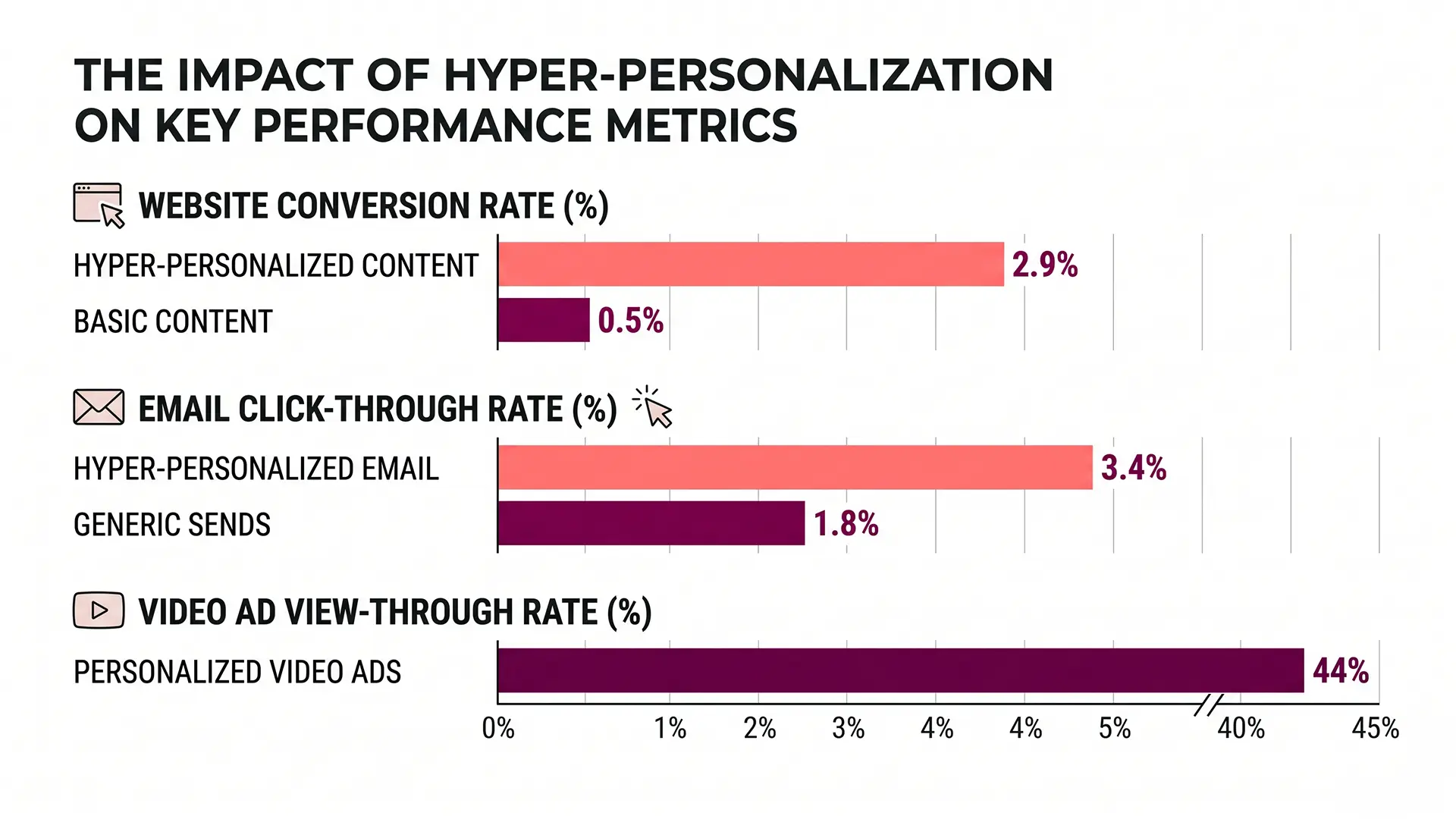
The data on hyper-personalized content cuts both ways on this tension. Sites using hyper-personalized content saw a 2.9% conversion rate compared to 0.5% for basic content. Hyper-personalized email hit a 3.4% click-through rate against 1.8% for generic sends. Personalized video ads posted a 44% view-through rate (Deloitte). When it’s done well, hyper-personalization measurably outperforms the basic version. The skepticism above isn’t about whether personalization works. It’s about whether AI can be trusted to produce it well without a human checking its work.
That same gap between adoption and execution shows up in how brands actually run AI, not just what they think of it. Twilio’s 2025 State of Customer Engagement Report found that 90% of businesses say they offer real-time personalization. But real-time interactions make up only 44% of their actual customer engagement on average. Most brands are further from real-time than they think.
Part of the reason is that AI adoption isn’t strategic yet. 81% of businesses use AI mainly because it’s already embedded in the marketing tools they use, not because of a deliberate decision to adopt it (Twilio). That’s despite 97% of businesses planning to increase their AI and data budgets over the next year. Budgets are climbing faster than strategy is catching up.
Deloitte’s Digital Marketing Trends 2026 report, based on a 2025 survey of 1,854 executives across EMEA, found that only 10% of organizations are realizing significant ROI from agentic AI. The investment is real. The payoff mostly isn’t yet.
What’s Next
Personalization’s next chapter is being written by AI, and brands aren’t waiting to see how it turns out. Investment is already moving.
That investment is running ahead of the results, the same pattern this article has traced through sourcing, execution, and trust. Brands going all-in on AI now aren’t chasing a return that’s already arrived. They’re betting on where the category is headed.
That bet is also getting cheaper to place. The production gains covered earlier in this piece mean testing personalized creative at scale no longer requires the budget it used to, even while the trust and execution questions raised in earlier sections are still being worked out.
Where does that leave brands right now? Somewhere between invest now and expect a payoff later. The tools are getting cheaper and faster. The judgment about how and where to use them is still catching up. That’s exactly the kind of shift we’ll dig into in our 2027 personalization trends outlook: which experiments become standard practice, and which brands solve the trust problem before their competitors do.
In the meantime, one of the lowest-effort ways to start testing personalization without waiting on a bigger AI roadmap is still a countdown timer. It updates in real time, works across email and web, and doesn’t require solving the trust problem this article just spent three sections on. If you want to see what that looks like in practice, our email countdown timer hub walks through it.
Try for freeFrequently Asked Questions
Yes. 93% of marketers report that personalization improves leads or purchases (HubSpot), and the effect shows up in hard performance numbers too: sites using hyper-personalized content see a 2.9% conversion rate compared to 0.5% for basic content, and hyper-personalized email hits a 3.4% click-through rate against 1.8% for generic sends (Deloitte, Digital Marketing Trends 2026).
Mixed, and for different reasons depending on the person. 21% of consumers say AI-driven personalization feels too personal or intrusive, while 14% say the opposite problem, that it feels overly human-like in a way that makes them uncomfortable (Klaviyo). Trust is the bigger issue underneath both reactions: only 42% of consumers trust businesses to use AI ethically (Deloitte, Digital Marketing Trends 2026).
Very. 88% of consumers are more likely to buy when a brand personalizes in the moment rather than after the fact, and 35% say they’re significantly more likely to buy (Twilio, 2025 State of Customer Engagement Report). Miss that moment and the cost is immediate: 40% of consumers will search for alternatives, 30% will buy from a different brand, and 28% will abandon the purchase altogether.
Mostly people and process, not technology. Only 18% of organizations have a dedicated program owner and support team for personalization, and 46% have to pull staff off other priorities whenever a project comes up (Mastercard, Personalization Maturity Report 2026). 71% say they’ve identified useful data for personalization but haven’t integrated or prioritized it yet.
Real-time countdown timers are one of the lowest-effort starting points. Per Litmus, they’re already the number one email personalization tactic marketers use, and platforms like DynaPictures let one marketer generate personalized images and timers in around 200ms and batch them through a spreadsheet, CSV, Airtable, Zapier, or API, without waiting on a developer or a bigger AI roadmap.
Sources
- State of Customer Engagement Report by Twilio (2025).
- Personalization Maturity Report 2026 by Mastercard Dynamic Yield (2026).
- Digital Marketing Trends 2026 by Deloitte (2026).
- State of Personalization in Retail 2026 by Amperity (2026).
- State of Sales, 7th Edition by Salesforce (2026).
- HubSpot State of Marketing by HubSpot (2026).
- The future of marketing personalization by Klaviyo (2026).
- Customer experience personalization and optimization software and services revenue worldwide from 2020 to 2026 by Statista
